

 App Store
 Profile
 Security
 Sign Out
 Feeds
Feeds
 Articles
How a Polymarket Trader Lost $2M in 35 Days: A Case Study in Negative Expectancy
 Lookonchain
1/ Trader "beachboy4" lost over $2M in just 35 days on Polymarket.
Let's dig into his trades to see how he lost money and what lessons we can learn.
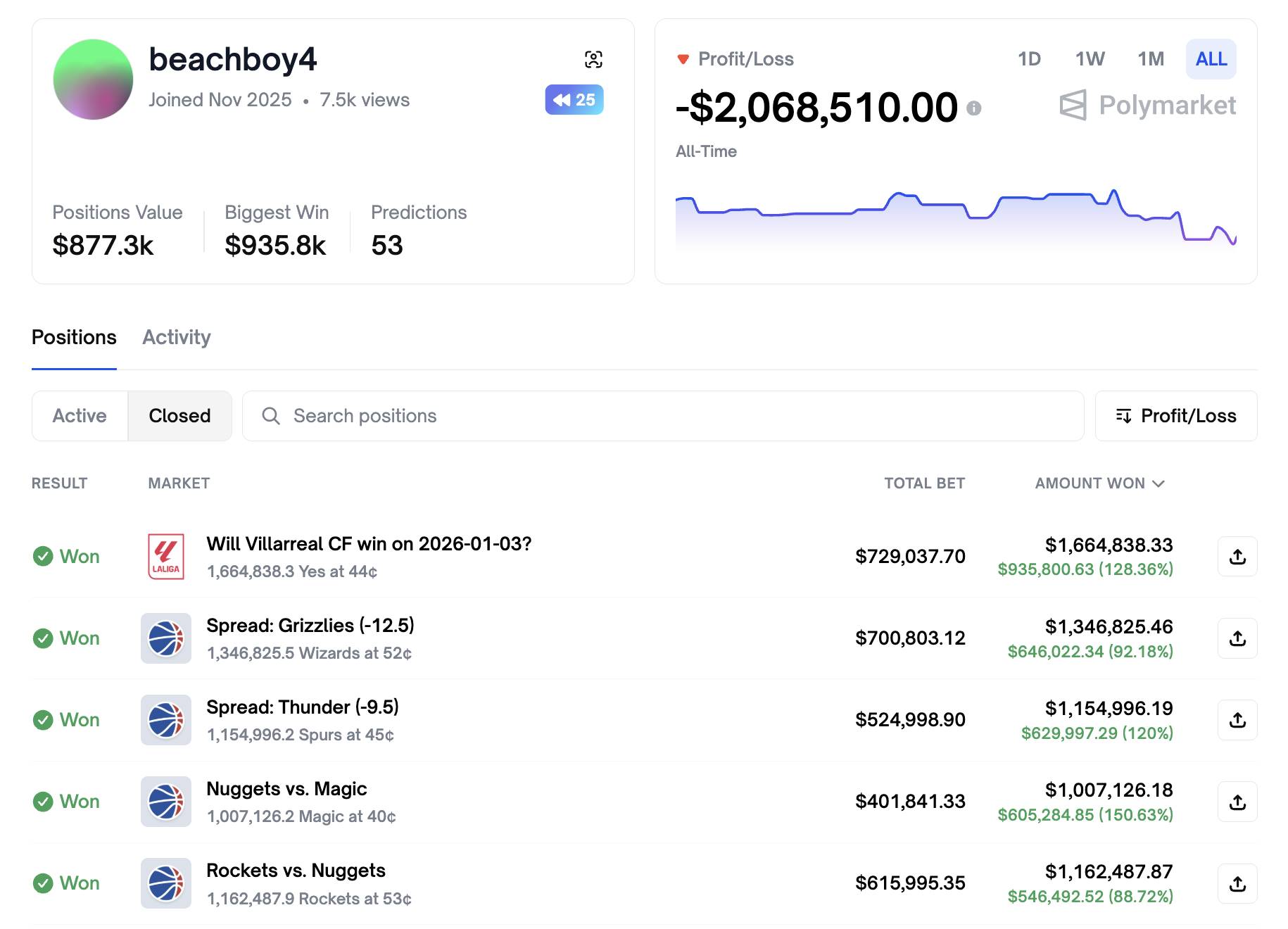
2/ First, the key stats:
Trading period: 35 days
Total predictions: 53
Wins: 27
Win rate: 51%
Biggest win: $935.8K
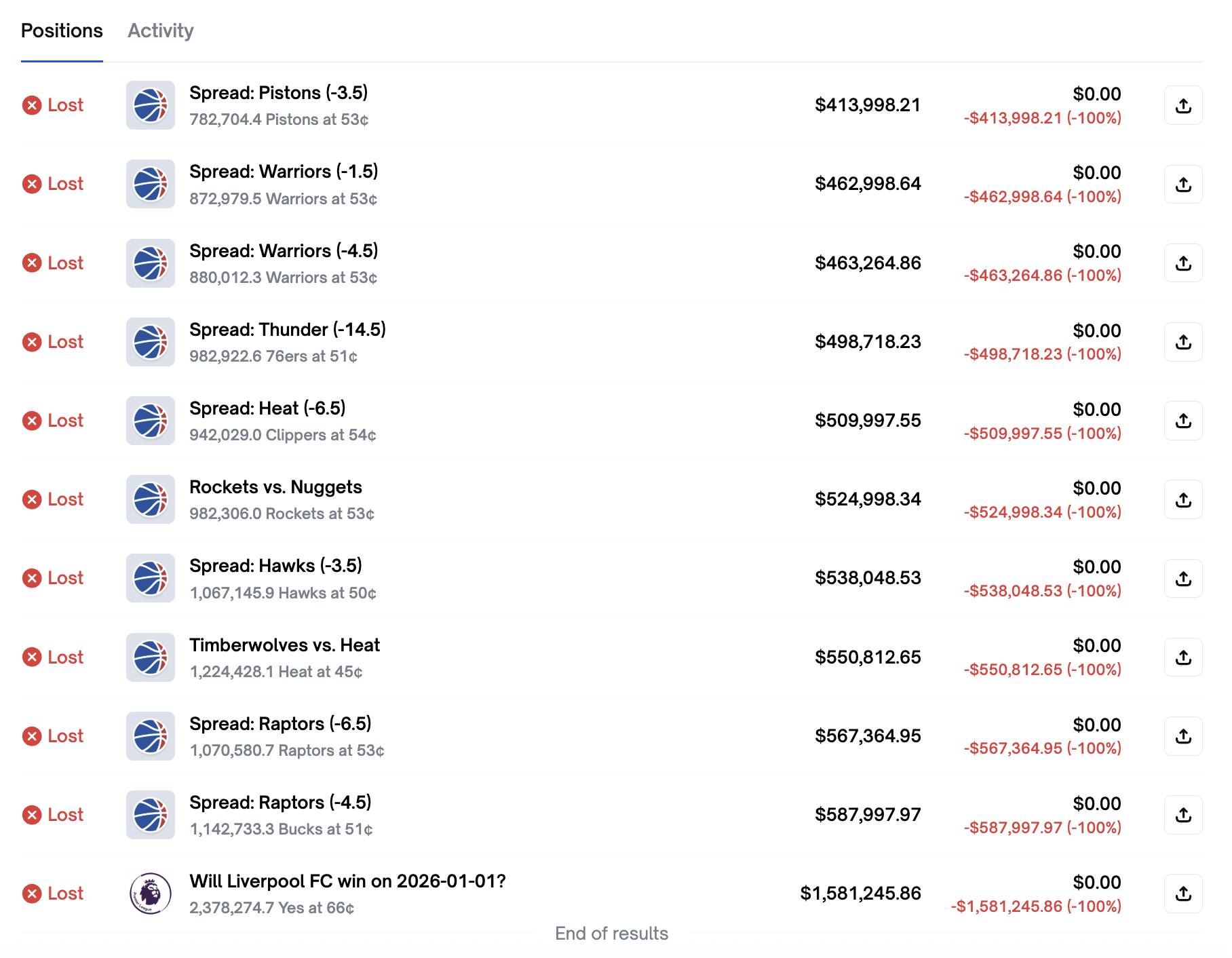
Biggest loss: $1.58M
Avg bet per event: ~$400K
Max bet per event: ~$1.58M
This isn't trading, this is gambling.
3/ The Biggest loss:
Liverpool to win (buy at $0.66): –$1.58M
Buying "YES" at $0.66 does not mean:
"Liverpool is likely to win"
It means:
"I believe the true probability is higher than 66%"
Polymarket is a probability market, not a bookmaker.
This trader consistently treated Polymarket like binary sports betting, not probability trading.
This single mistake is enough to explain most of the losses.
4/ This wallet repeatedly paid a premium for consensus
Across major losses:
Buy prices clustered at 0.51 – 0.67
Most positions had:
Upside: +50% to +90%
Downside: –100%
This is the worst payoff structure in Polymarket:
capped upside + total loss downside
5/ No exits. No hedging. No damage control.
Polymarket allows:
Early exits
Partial profit-taking
Probability-based stop losses
This trader used none of them.
Most losing positions were held all the way to zero, even when prices collapsed long before resolution.
That's not trading — that’s waiting for a verdict.
6/ Repeated all-in behavior
This wallet repeatedly placed extremely large single-position bets on:
NBA spreads
Soccer favorites
"High confidence" outcomes
In markets where:
Information is public
Pricing is efficient
Upside is capped
Downside is total loss
High confidence ≠ positive expected value.
7/ Hidden truth: the trader wasn’t unlucky
This wasn’t bad luck.
This wallet had:
Negative payoff asymmetry
No defined max loss per position
No edge in efficient markets
No probability discipline
Loss was inevitable.
8/ How to avoid repeating this mistake (practical rules)
Rule 1: Avoid high-price entries
Be extremely cautious above 0.55
Especially avoid 0.65+ unless you have strong informational edge
Rule 2: Cap single-event risk
Max 3–5% of total capital per event
One outcome should never decide your account
Rule 3: Trade price movement, not just resolution
Take partial profits
Cut losses when probability collapses
Don’t wait for “yes or zero”
Rule 4: Track win rate vs break-even rate
If your win rate < break-even → stop and reassess
Volume won’t fix a negative expectancy
Rule 5: Kill losing markets early
Persistent underperformance = no edge
Remove those markets entirely
 Source
 Add to Favorites
 Download image
 Share x
 Copy link
Bitcoin may enter a prolonged sideways phase between $57K and $87K as markets enter a relief period following a 52% drop from ATH. This consolidation could mirror the 2022 fractal, creating liquidity before a potential breakdown toward the $44K–$50K range.
Doctor Profit/2026.03.09

Davinci Jeremie urged people to buy $1 of Bitcoin in 2013 and became a symbol of early conviction. Years later, fame, lifestyle flexing, and token promotions sparked criticism. His journey reflects both crypto foresight and influencer-era controversy.
StarPlatinum/2026.03.04
A sweeping narrative ties Jane Street to India’s expiry-day options case, alleged 10AM Bitcoin sell patterns, Terra’s collapse, and ETF plumbing. While none prove misconduct, critics argue a common structure: move spot, monetize derivatives, keep execution opaque.
Bull Theory/2026.02.27
A controversial narrative links Jane Street, ETF mechanics, and Bitcoin’s price behavior, pointing to lawsuit allegations, 10AM volatility patterns, and derivative hedging dynamics. The discussion raises broader questions about liquidity, structure, and price discovery.
Justin Bechler/2026.02.26
A new federal lawsuit alleges Jane Street exploited non-public information tied to Terraform’s liquidity defenses, accelerating UST’s depeg and the Terra collapse. The firm denies the claims. The case may reignite debates on structure, design, and regulation.
Diana/2026.02.25
Mean reversion and on-chain models sit at levels historically linked to bottom formation after capitulation. Realized losses reached record USD values, while deviations from anchor models remain extreme. Price pain may be fading; patience remains key.
Checkmate/2026.02.25
Hot feeds
A trader profits $448K by monitoring #Binance's new listings!
2024.12.13 17:37:29
Last week, funds have flowed into #Bitcoin, #Ethereum, and #Hyperliquid.
2024.12.16 14:48:36
A $PEPE whale that had been dormant for 600 days transferred all 2.1T $PEPE($52M) to a new address.
2024.12.14 10:35:27
When Elon Musk tweeted about Moltbook, the meme coin MOLT experienced a short-term 30% price surge, hitting a new all-time high of $114 million.
2026.01.31 18:37:29
A smart #AI coin trader made $17.6M on $GOAT, $ai16z, $Fartcoin,$arc.
2025.01.05 16:05:18
A sniper earned 2,277 $ETH ($8.3M) trading $SHIRO within 18 hours!
2024.12.03 23:09:08
MoreHot Articles
How did I turn $1,000 into $30,000 with smart money?
2024.12.09
10 promising AI Agent cryptos
2024.12.05
The 30-Year-Old Entrepreneur Behind Virtual, a Multi-Million Dollar AI Agent Society
2025.01.22
10 smart traders specializing in MEMEcoin trading on Solana
2024.12.09
A trader lost $73.9K trading memecoins in just 3 minutes — a lesson for us all!
2024.12.13
What is $SPORE? Let us take you through the on-chain records to show you how it works.
2024.12.25

