
Lookonchain APP

App Store

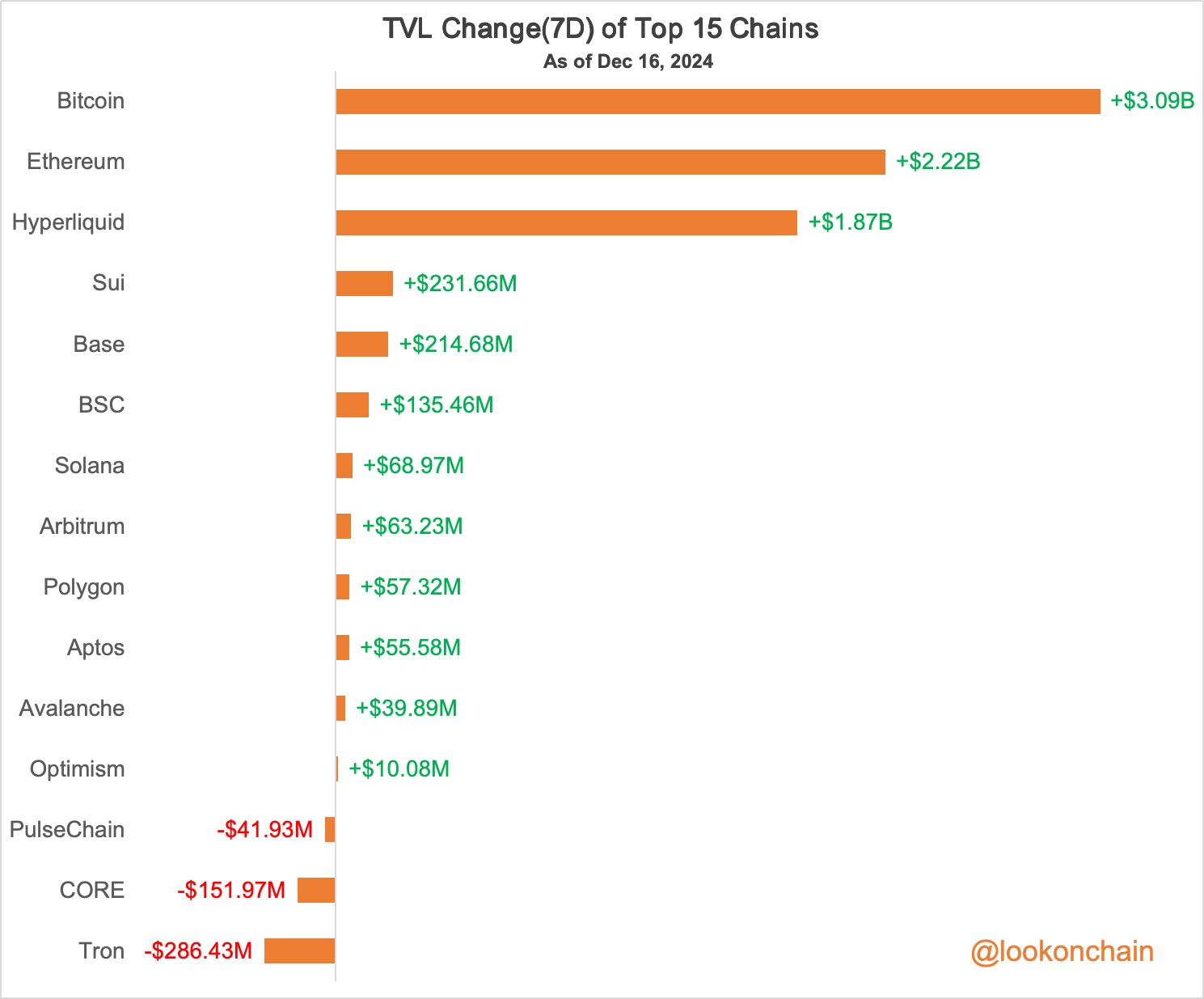
Last week, funds have flowed into #Bitcoin, #Ethereum, and #Hyperliquid.

2024.12.16 14:48:36

In the past 7 days, #Bitcoin's TVL increased by $3.09B, #Etherum's TVL increased by $2.22B, and #Hyperliquid's TVL increased by $1.87B.

Funds have flowed into #Bitcoin, #Ethereum, and #Hyperliquid.
Relevant content

Coinbase secures Luxembourg’s MiCA license, to base its EU operations in Luxembourg.

According to an official announcement, Luxembourg has officially become Coinbase’s registered MiCA Home under the EU’s Markets in Crypto-Assets (MiCA) framework. Moving forward, Coinbase will use Luxembourg as its EU business hub to provide compliant crypto asset services for users across EU member states.

3 minutes ago

The KyberSwap attacker has transferred another 2000 ETH to Tornado Cash, with over 80% of the stolen funds now laundered.

According to PeckShield’s monitoring, an address identified as the KyberSwap attacker has once again transferred 2,000 ETH to Tornado Cash. Over the past two years, this attacker has cumulatively transferred and mixed 16,100 ETH via Tornado Cash, equivalent to roughly $40 million at current prices, accounting for over 80% of the $48.8 million lost in the KyberSwap attack in November 2023. Some of the stolen funds have not yet been fully transferred.

3 minutes ago

James Wynn closed out his 40x Bitcoin short position, netting $30,000 in profits, and shifted to opening a 50x S&P 500 short position.

According to monitoring by OnchainLens, James Wynn has liquidated his 40x leveraged Bitcoin (BTC) short position, pocketing roughly $30,000 in profit. He subsequently opened a new 50x leveraged S&P 500 (SP500) short position at a price of 334.42, betting on a future decline in the US stock market.

3 minutes ago

Micron's conference call delivers strong signals: the memory shortage will continue until 2028, and AI long-term contracts are rewriting the industry cycle narrative.

Micron Technology (MU) revealed in its early-morning earnings call that its strategic customer agreements rose from 1 to 16 sequentially, covering roughly 20% of its DRAM shipments and around one-third of its NAND shipments. Of these deals, 14 calculated at minimum contract prices represent a cumulative remaining revenue of approximately $100 billion. CEO Sanjay Mehrotra said these agreements will "fundamentally transform" the company’s business model. The key takeaway for the market is that Micron is being repositioned from a highly cyclical memory stock to an AI infrastructure provider with far greater revenue visibility. During the call, Micron disclosed it expects industry tightness to persist beyond 2027, and even as supply gradually improves in 2028, there is no clear timeline for supply to catch up with demand. Management attributed this gap to the large scale, complexity, and long lead times of new semiconductor fab construction. CFO Mark Murphy noted that DRAM revenue jumped 343% year-over-year to $31.3 billion, while NAND revenue surged 361% YoY to $9.9 billion. DRAM prices rose in the low-60% range, and NAND prices increased in the mid-80% range. He explained that the quarter’s earnings, which handily beat market expectations, were driven more by pricing power and supply-demand imbalances rather than just shipment volume. The company forecasts capital expenditure of roughly $10 billion this quarter, and $27 billion for full fiscal 2026. Fiscal 2027 quarterly capex will exceed the FY2026 fourth quarter level, with more than half allocated to cleanroom construction. However, the CFO also stated that free cash flow for the current quarter is expected to continue rising sharply. Overall, the call’s messaging sent three key signals to the market: persistent memory shortages, customer willingness to sign long-term agreements, and further upside for prices. This drove Micron’s (MU) shares to surge nearly 16% in U.S. post-market trading.

3 minutes ago

A poll shows that a majority of U.S. voters support federal unified regulation of prediction markets.

Two polls commissioned by the Coalition for Prediction Markets show that U.S. Republican and Democratic voters both prefer federal-level unified regulation of prediction markets over state-by-state oversight. Among Republican respondents, 48% support a federal regulatory framework, while only 27% back state-level regulation. For Democratic voters, 45% favor federal regulation, compared to 35% who support state-level rules. Only 8% of respondents believe prediction markets should be banned in the U.S., and a majority of voters support consumer autonomy to choose whether to participate in such markets. The survey also found that people under 35 have the highest acceptance of prediction markets, with more than half of young respondents expressing interest in using or having already used related platforms. Currently, the U.S. Commodity Futures Trading Commission (CFTC) and prediction market platforms including Kalshi and Polymarket are in disputes with multiple state governments over regulatory authority, with the core focus being whether sports event contracts qualify as prediction market products subject to federal regulation.

3 minutes ago

Analysis: Bitcoin miners face profit pressure, with around 20% of mining firms now operating below the break-even point.

Bitcoin miners' revenue continues to decline, with the current 7-day average daily income dropping to around $30 million, a notable pullback from the over $50 million level seen last summer. Meanwhile, on-chain transaction fee revenue has fallen to less than $250,000, accounting for an extremely small share of miners' total income. Data from JPMorgan Chase shows the average production cost is approximately $78,000, and Bitcoin’s price has remained below this level for five consecutive months — the longest such stretch in the current cycle. An estimated 20% of miners are already operating at a loss; some high-cost miners have begun frequently powering their mining rigs on and off in response to price fluctuations, leading to a stronger correlation between network hash rate difficulty and Bitcoin’s price. Additionally, Bitcoin’s mining difficulty was adjusted down by roughly 10% in the second week of June, marking the second pullback of the same magnitude this year. Publicly listed mining companies, meanwhile, are relying more on their balance sheets to sustain operations, selling over 32,000 BTC in the first quarter alone to cover operating costs. Analysts note that against the backdrop of continuously shrinking block subsidies and stagnant fee revenue, a recovery in miners’ profits will primarily depend on a rise in Bitcoin’s price.

3 minutes ago