

 App Store
 Profile
 Security
 Sign Out
 Feeds
Feeds
 Articles
Trading the Meme: How Polymarket’s Most Mocked Market Becomes a Consistent Cash Machine
 Dexter's Lab
The 𝗠𝗢𝗦𝗧 misunderstood market on Polymarket...
99% just laugh and scroll.
1% makes 𝗧𝗛𝗢𝗨𝗦𝗔𝗡𝗗𝗦 on it 𝗘𝗩𝗘𝗥𝗬 𝗬𝗘𝗔𝗥.
Jesus Christ's return is 𝗡𝗢𝗧 about religion.
It’s about understanding how this market trades and making money on it.
Every single year, this market does the same thing:
> 𝗘𝗮𝗿𝗹𝘆 𝗶𝗻 𝘁𝗵𝗲 𝘆𝗲𝗮𝗿:
Price shifts between 2-4%
Driven by whales, bots, and curious normies.
> 𝗔𝘀 𝘁𝗵𝗲 𝘆𝗲𝗮𝗿 𝗽𝗿𝗼𝗴𝗿𝗲𝘀𝘀𝗲𝘀:
Liquidity dries up and attention fades
Price bleeds toward ~0.01% into year end.
So if you’re holding 𝗬𝗘𝗦 late - you’re exit liquidity.
The 𝗢𝗡𝗟𝗬 way to make money is simpler than you think:
> Buy YES below 2%
> ONLY during whale sell-offs
> Sell into rebounds at 3-4%
> Never hold into late year
At 2% -> 4% is a clean 2x
At 1.5% -> 4% is closer to 2.5-3x
No miracle required.
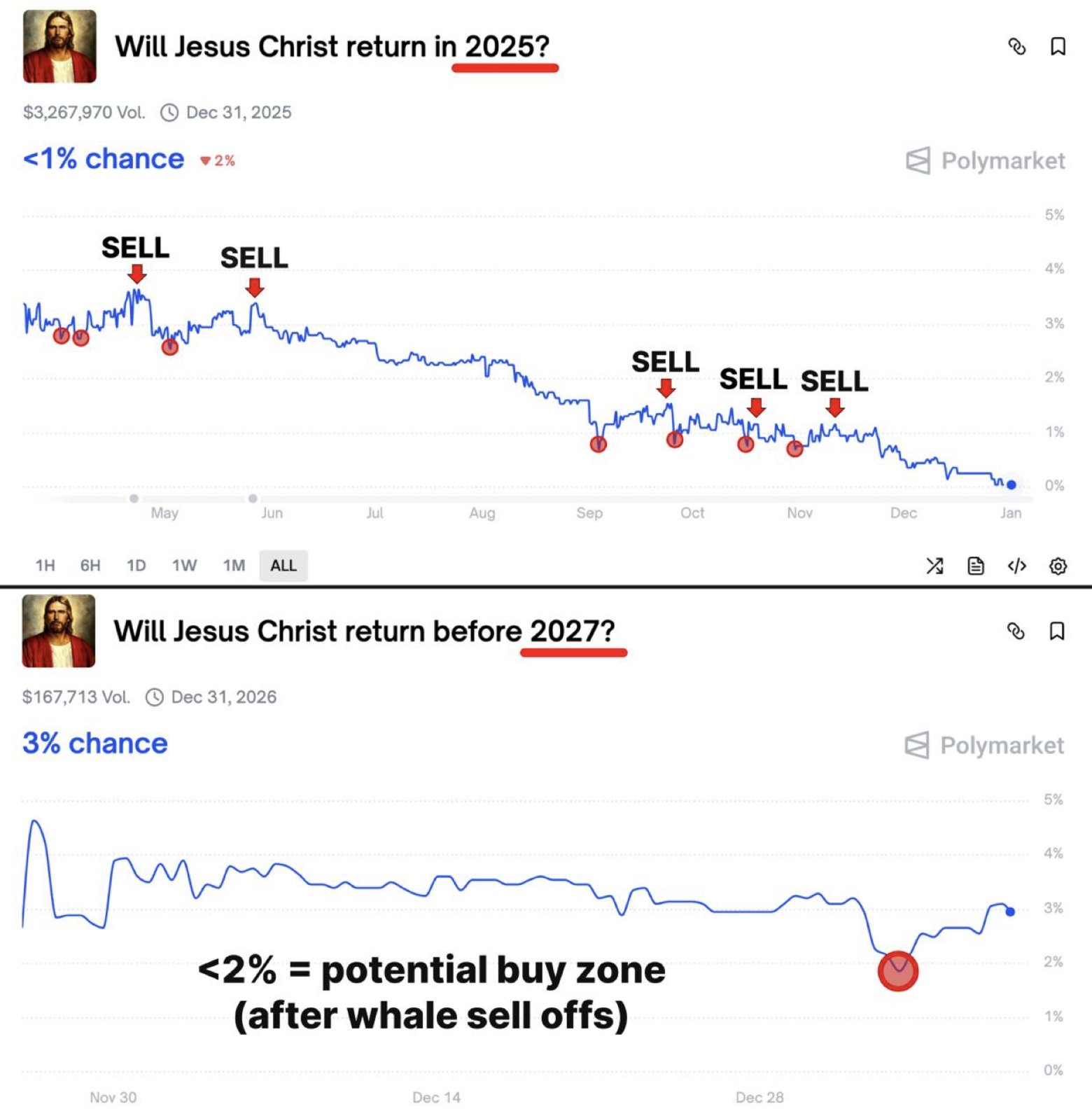
And if you open the 2027 chart, you'll see that a few days ago the price dumped from 3.2% to 1.9%
Those who tracked sell offs quickly bought the dip and made ~100% profit in HOURS.
𝗠𝗮𝗿𝗸𝗲𝘁 𝗹𝗶𝗻𝗸: [https://polymarket.com/event/will-jesus-christ-return-before-2027?via=dexter-molu]
𝗪𝗵𝘆 𝘁𝗵𝗶𝘀 𝘄𝗼𝗿𝗸𝘀:
> Low liquidity = small size moves price
> Random whales dump size so price crashes
> Normies buy back later so price goes up
> No anchoring news to stop the cycle
This is close to trading a low-cap memecoin btw.
Same psychology and same inefficiency.
𝗪𝗵𝘆 𝘁𝗵𝗶𝘀 𝗺𝗮𝗿𝗸𝗲𝘁 𝗲𝘅𝗶𝘀𝘁𝘀? (2025's did $3.3M+ volume)
> Meme appeal
> Long-shot psychology
> Degens love low-probability lottery tickets
> New users click it first
> Whales farm volatility
𝗜𝗻 𝗼𝘁𝗵𝗲𝗿 𝘄𝗼𝗿𝗱𝘀: attention makes all the hustle.
But that’s exactly why it’s tradable.
𝗔𝗗𝗩𝗔𝗡𝗖𝗘𝗗 𝗠𝗢𝗗𝗘 (for active traders)
Track every whale sell-off during the year:
> Catch the knife
> Sell the bounce
> Repeat
That’s literally how the 2025 market traded (check the attached pic).
And 2026 is already rhyming (check the comparison chart).
𝟮𝟬𝟮𝟱 𝗺𝗮𝗿𝗸𝗲𝘁 𝗹𝗶𝗻𝗸: [https://polymarket.com/event/will-jesus-christ-return-in-2025?via=dexter-molu]
This isn’t a joke market.
It’s a mechanical volatility loop hiding behind a meme.
If you treat it like a belief bet, you lose.
If you treat it like structure, you get paid.
Polymarket rewards those who trade behavior, not narratives.
Hope my post clarified this market for you a bit.
Always DYOR before placing a bet.
 Source
 Add to Favorites
 Download image
 Share x
 Copy link
Bitcoin may enter a prolonged sideways phase between $57K and $87K as markets enter a relief period following a 52% drop from ATH. This consolidation could mirror the 2022 fractal, creating liquidity before a potential breakdown toward the $44K–$50K range.
Doctor Profit/2026.03.09

Davinci Jeremie urged people to buy $1 of Bitcoin in 2013 and became a symbol of early conviction. Years later, fame, lifestyle flexing, and token promotions sparked criticism. His journey reflects both crypto foresight and influencer-era controversy.
StarPlatinum/2026.03.04
A sweeping narrative ties Jane Street to India’s expiry-day options case, alleged 10AM Bitcoin sell patterns, Terra’s collapse, and ETF plumbing. While none prove misconduct, critics argue a common structure: move spot, monetize derivatives, keep execution opaque.
Bull Theory/2026.02.27
A controversial narrative links Jane Street, ETF mechanics, and Bitcoin’s price behavior, pointing to lawsuit allegations, 10AM volatility patterns, and derivative hedging dynamics. The discussion raises broader questions about liquidity, structure, and price discovery.
Justin Bechler/2026.02.26
A new federal lawsuit alleges Jane Street exploited non-public information tied to Terraform’s liquidity defenses, accelerating UST’s depeg and the Terra collapse. The firm denies the claims. The case may reignite debates on structure, design, and regulation.
Diana/2026.02.25
Mean reversion and on-chain models sit at levels historically linked to bottom formation after capitulation. Realized losses reached record USD values, while deviations from anchor models remain extreme. Price pain may be fading; patience remains key.
Checkmate/2026.02.25
Hot feeds
A trader profits $448K by monitoring #Binance's new listings!
2024.12.13 17:37:29
Last week, funds have flowed into #Bitcoin, #Ethereum, and #Hyperliquid.
2024.12.16 14:48:36
A $PEPE whale that had been dormant for 600 days transferred all 2.1T $PEPE($52M) to a new address.
2024.12.14 10:35:27
When Elon Musk tweeted about Moltbook, the meme coin MOLT experienced a short-term 30% price surge, hitting a new all-time high of $114 million.
2026.01.31 18:37:29
A smart #AI coin trader made $17.6M on $GOAT, $ai16z, $Fartcoin,$arc.
2025.01.05 16:05:18
A sniper earned 2,277 $ETH ($8.3M) trading $SHIRO within 18 hours!
2024.12.03 23:09:08
MoreHot Articles
How did I turn $1,000 into $30,000 with smart money?
2024.12.09
10 promising AI Agent cryptos
2024.12.05
The 30-Year-Old Entrepreneur Behind Virtual, a Multi-Million Dollar AI Agent Society
2025.01.22
10 smart traders specializing in MEMEcoin trading on Solana
2024.12.09
A trader lost $73.9K trading memecoins in just 3 minutes — a lesson for us all!
2024.12.13
What is $SPORE? Let us take you through the on-chain records to show you how it works.
2024.12.25

