
Lookonchain APP

App Store

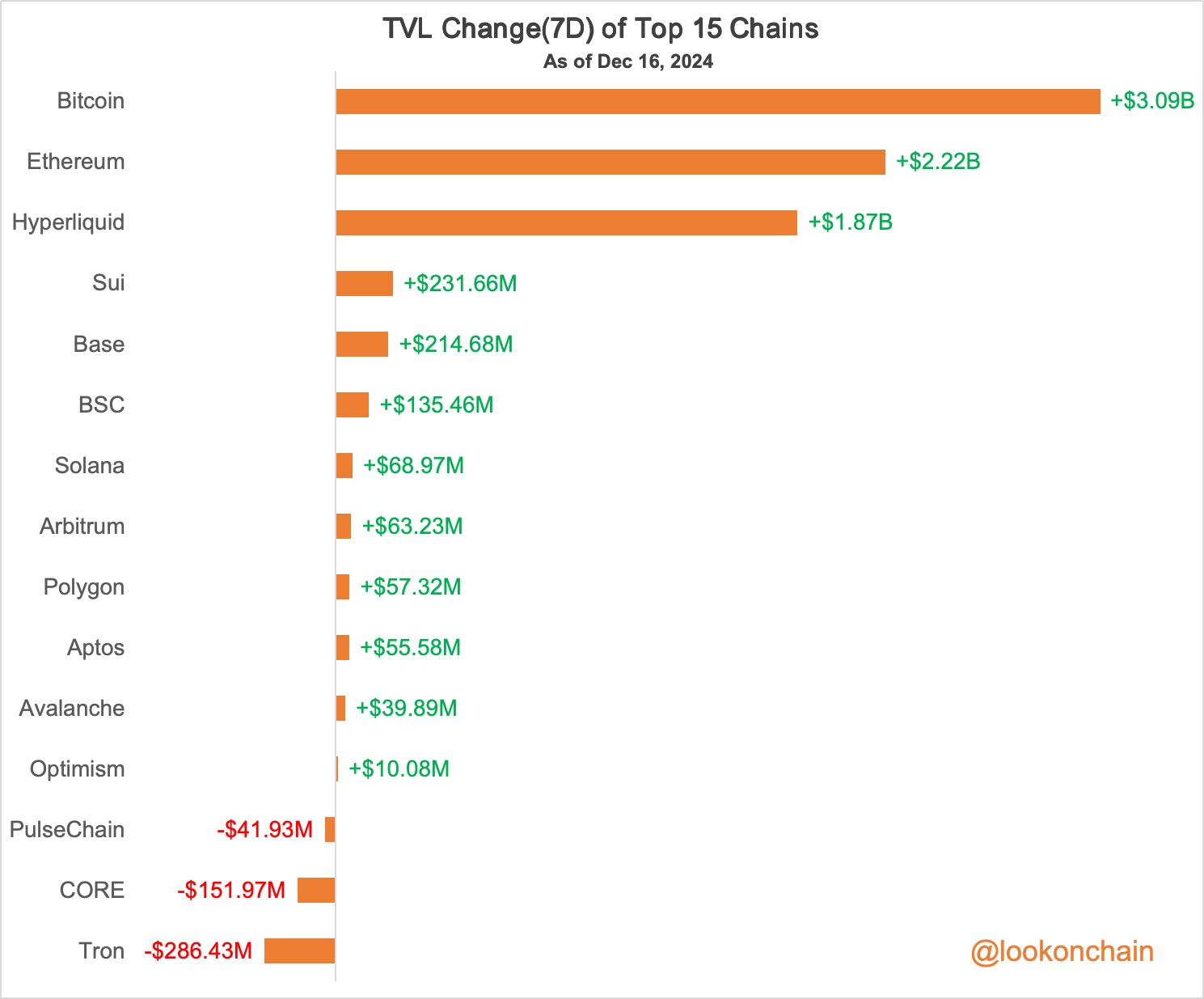
Last week, funds have flowed into #Bitcoin, #Ethereum, and #Hyperliquid.

2024.12.16 14:48:36

In the past 7 days, #Bitcoin's TVL increased by $3.09B, #Etherum's TVL increased by $2.22B, and #Hyperliquid's TVL increased by $1.87B.

Funds have flowed into #Bitcoin, #Ethereum, and #Hyperliquid.
Relevant content

Bridgewater founder once advised Elon Musk not to risk his entire fortune on Mars exploration, and Musk responded, "There is no need for a backup plan"

Bridgewater founder Ray Dalio once warned Elon Musk against plowing most of his proceeds from selling PayPal into Mars exploration, a move Musk pushed back on at the time, saying "I don't need to do that". Dalio recently recalled the exchange during a podcast, noting he first met Musk in 2002 while researching entrepreneur personality types, classifying the Tesla and SpaceX CEO as a "shaper"—a term for individuals with grand visions who are passionate about turning ideas into reality. According to Dalio, after selling PayPal, Musk received roughly $180 million, most of which he poured into startup ventures: around $100 million to SpaceX, $70 million to Tesla, and $10 million to solar firm SolarCity. Dalio advised Musk to hold back some cash as a safety buffer, telling him "If things go south, you’ll at least have some funds left." Musk’s response: "No, I don’t need that." Dalio added that Musk is not primarily driven by wealth accumulation, but rather focused on achieving long-term goals. One of SpaceX’s core missions is building the technology framework to make humanity a "multiplanetary species." Following SpaceX’s historic IPO on Nasdaq this summer, investors gained their first in-depth look at the company’s strategy, with its prospectus stating its mission is "to build the systems and technologies required for life to become multiplanetary." Dalio also highlighted that "shapers" like Musk combine a far-reaching, big-picture strategic vision with extreme attention to detail. He recalled Musk once showing him specific details of Tesla vehicles and discussing concrete ideas such as sending plant watering systems to Mars. For now, Mars exploration remains a central part of SpaceX’s long-term strategy, and Musk continues to place big bets on areas including rockets, satellites, and artificial intelligence.

7 minutes ago

Robinhood Chain has notched over $9 billion in DEX trading volume in its first three weeks since launch, with its weekly trading volume ranking among the top five across all blockchains.

According to data from GMGN and DeFiLlama, Robinhood Chain has surpassed $9 billion in cumulative DEX trading volume since its mainnet launch on July 1. Roughly $4.04 billion of that volume came in just the past seven days, placing the chain among the top five globally for trading volume and briefly outperforming ecosystems including Polygon, Hyperliquid L1, and Arbitrum. Trading on Robinhood Chain has grown rapidly since launch: its first week DEX volume was less than $100 million, but it surged sharply starting July 8, with daily trading repeatedly topping $500 million, driven by massive speculative inflows from the chain’s meme asset CASHCAT. Current trading remains highly concentrated in the Uniswap ecosystem: Uniswap V2/V3/V4 accounted for 96% of the chain’s trading volume over the past seven days. Positioned as an Ethereum L2 built on the Arbitrum tech stack, Robinhood Chain targets financial services and real-world assets (RWAs); stock tokens can be traded via Robinhood Wallet and protocols like Uniswap. Per DeFiLlama data, the chain’s current DeFi total value locked (TVL) is approximately $305 million, its stablecoin market cap is ~$439 million, and its active RWA market cap is ~$64.22 million. Meme coins like CASHCAT still dominate top trading pairs, while stock tokens have not yet become a major trading source.

7 minutes ago

Bitcoin mining pool Foundry has launched a vote, with miners set to decide whether to support the BIP-110 proposal.

One of Bitcoin’s largest mining pools, Foundry USA, is inviting its miner clients to vote on whether the pool will support Bitcoin Improvement Proposal (BIP) 110. BIP-110 is a hotly debated soft fork proposal aimed at reducing the volume of storable data in Bitcoin transactions, to limit non-monetary transaction types such as Ordinals from occupying Bitcoin network space. Foundry stated it has provided relevant proposal materials to its miner clients, with the voting window set to close at Bitcoin block height 961,632, expected in early August. Miners can participate in the vote via a link sent to their emails. BIP-110 is currently one of the most divisive proposals in the Bitcoin community. Supporters argue the proposal helps ease pressure on block space from non-financial transactions, while opponents worry it could harm the openness of the Bitcoin network. Blockstream CEO Adam Back has publicly opposed BIP-110, claiming it could be used to freeze user funds. Strategy Executive Chairman Michael Saylor also criticized the proposal, saying it might disrupt some normal transactions. According to Hashrate Index, Foundry USA currently holds approximately 23.8% of Bitcoin’s total network hash rate, making it one of the world’s largest Bitcoin mining pools. Its stance on BIP-110 could impact future community discussions and deployment of the proposal.

7 minutes ago

Moonveil accelerates capitalization, targets $50 billion valuation post Kimi K3 launch

Chinese AI large language model (LLM) firm Moonshot AI is accelerating its capitalization process, with plans to launch negotiations for its final pre-IPO funding round in August, targeting a pre-money valuation of $50 billion. Reports indicate Moonshot AI is expected to close a funding round soon at a valuation of roughly $31.5 billion. Upon closing this round, the company will immediately begin discussions for its next funding round with potential investors, which is likely to be its final private placement before listing on Hong Kong’s stock market. Market observers note that if the funding plans proceed smoothly, Moonshot AI could kick off its Hong Kong IPO process as early as this year. A key driver behind the valuation hike is the company’s recently launched next-generation LLM, Kimi K3. According to announcements, Kimi K3 has a parameter count of 2.8 trillion, supports a million-token context window, and ranks among the world’s largest open-source models by parameter size to date. The model quickly drew market attention, prompting the company to temporarily adjust new user subscription arrangements to maintain service quality for existing users. As generative AI competition shifts to a race for computing power, user scale, and commercialization capabilities, LLM firms are accelerating their pursuit of capital support. Moonshot AI’s latest funding plans also reflect the market’s sustained focus on leading AI foundational model companies. However, the $50 billion valuation target also implies higher commercialization demands. Going forward, investors will closely monitor Moonshot AI’s revenue growth, computing power cost control, and whether the Kimi model line can establish a sustainable business model. If the funding and listing plans proceed smoothly, Moonshot AI could emerge as a key case of capitalization for China’s AI LLM enterprises.

7 minutes ago

Kraken’s parent company expands its tokenized stock business, with xStocks set to cover Hong Kong, UK, and South Korean stock markets.

Kraken parent company Payward has announced it is expanding its tokenized stock platform xStocks, with plans to extend coverage beyond the U.S. equities market to include Hong Kong, the U.K., South Korea and other international stock markets. Payward stated that it is partnering with investment infrastructure provider GTN to bring Hong Kong-listed stocks to the xStocks platform, and later plans to support U.K., European and South Korean equities after obtaining regulatory approval. This collaboration also lays the foundation for future expansion into other tokenized asset classes. Mark Greenberg, Payward’s global services head, noted that other global markets represent key untokenized asset classes, and the firm aims to gradually integrate global capital markets onto the blockchain via xStocks. Previously, xStocks primarily offered on-chain versions of U.S. stocks and ETFs, including popular assets such as Nvidia, Apple and Tesla. The platform currently supports over 500 tokenized securities, with cumulative trading volume exceeding $35 billion and nearly 200,000 holders. The products are not yet accessible to U.S. users. The expansion comes amid intensifying competition in the tokenized securities sector. Players including Robinhood, Coinbase, Nasdaq and the New York Stock Exchange are all advancing plans to tokenize stock assets. Citi previously forecast that the tokenized securities market could reach $5.5 trillion by 2030, with the tokenized stock segment accounting for roughly $2.6 trillion.

7 minutes ago

Sell-Side Warning: Google’s AI Capital Expenditure Set to Hit a New High, Projected to Reach $250 Billion by 2027

As Alphabet, Google’s parent company, prepares to release its second-quarter financial results after today’s U.S. stock market close, sell-side Wall Street analysts have issued a cautious consensus forecast for its future capital expenditure (Capex) trajectory. According to aggregated market data, analysts’ consensus forecast for Alphabet’s full-year 2026 Capex is roughly $186 billion, which aligns closely with the company’s previously raised official guidance range of $180–190 billion. This figure represents more than a five-fold increase from the $32.3 billion recorded in 2023, with funds earmarked primarily for AI data centers and computing infrastructure to support the ongoing expansion of Google Cloud and the Gemini model. Of greater note is the 2027 outlook. Morgan Stanley analyst Brian Nowak previously projected publicly that Alphabet’s Capex could jump further to roughly $250 billion next year. This aligns with remarks made by Alphabet CFO Anat Ashkenazi during multiple earnings calls, where she explicitly told investors that 2027 Capex would “increase significantly” compared to 2026. Market observers note that the surging Capex has put pressure on the company’s free cash flow (Q1 free cash flow fell approximately 47% year-over-year). During tonight’s earnings call, in addition to focusing on revenue and EPS performance, whether management will further raise its 2026 guidance and provide more specific details on 2027 spending levels will be key variables affecting stock price movements.

7 minutes ago