

 App Store
 Profile
 Security
 Sign Out
 Feeds
Feeds
 Articles
Unpacking BTCFi and New Yield Opportunities
 Messari Research
Primer
BTC's market cap is ~$1.8 trillion, yet 99% of BTC is idle, meaning it is not used onchain in DeFi to generate yield. BTC holders and Bitcoin developers have faced challenges building an onchain economy on Bitcoin, primarily due to a lack of programmability, custody options, and unsustainable yield.
Since the rise in smart contract platforms like Ethereum, which can handle more complex protocols and transactions, many attempts have been made to integrate DeFi into the Bitcoin network. Upgrades like Lightning Network (2018) boosted transaction speed, Taproot (2021) improved privacy and script flexibility for metaprotocols like Ordinals (2023), and BitVM (not launched yet) enabled Turing-complete smart contracts via offchain computation and onchain settlement.
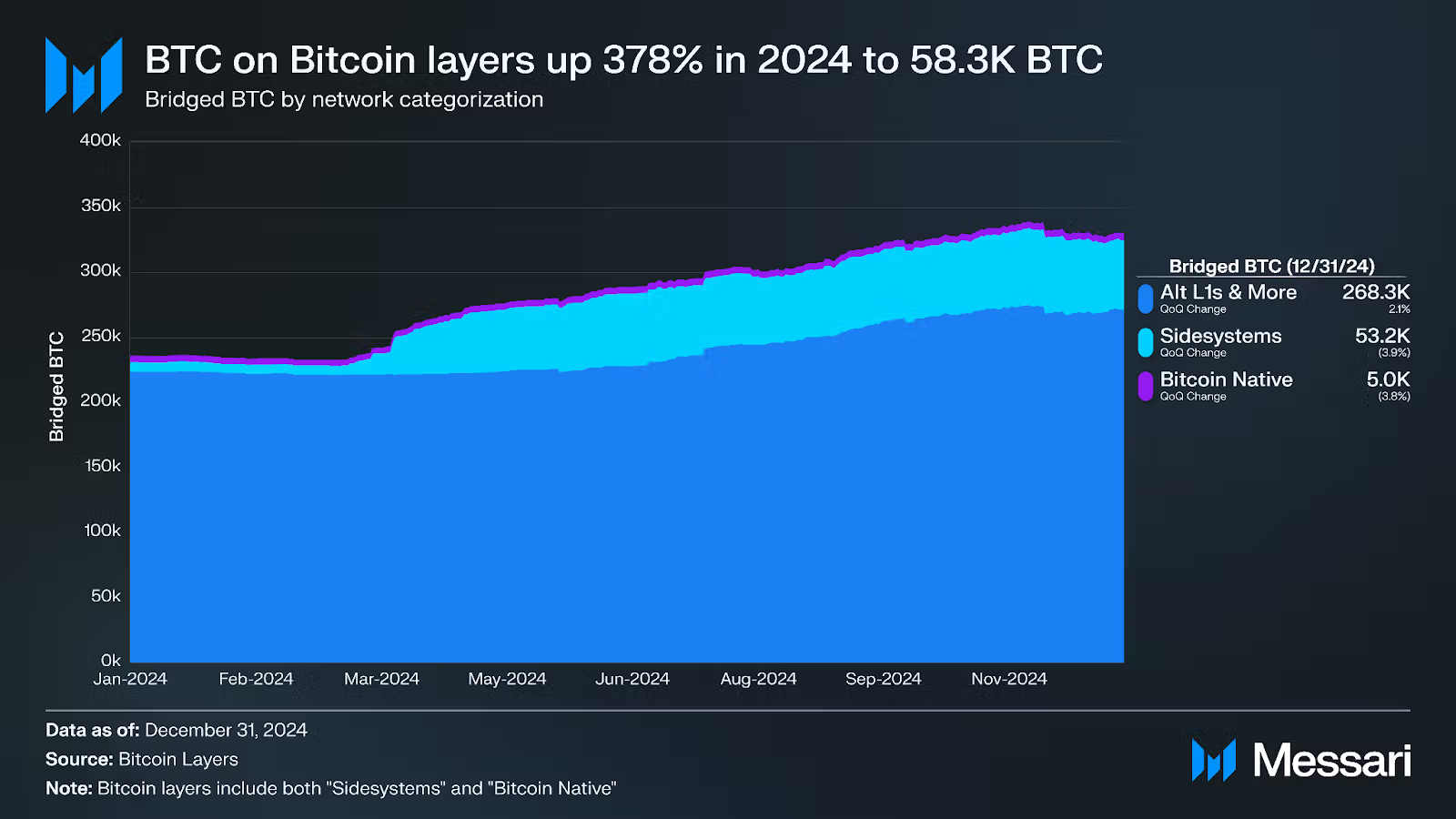
In Q4’24, 268,300 BTC was bridged to L1s and L2s (i.e., Ethereum, Solana, Arbitrum, etc.), and 53,200 BTC was bridged to sidesystems (i.e., Stacks, Merlin, Core, etc.). While BTC bridged to L1s and L2s was more dominant this past quarter, BTC bridged to side systems rose 378% in 2024 to 53,200 BTC, showcasing consistent growth. Users bridging BTC to sidesystems or swapping into wrapped alternatives may be doing so to use their BTC more productively. This implies that while BTC DeFi is still more popular on alt L1s, there is accelerating interest in using BTC in more native settings.
Despite Bitcoin’s TVL-to-market cap ratio being significantly lower than Ethereum's, even modest adoption of BTCFi (DeFi on the Bitcoin Network) could unlock substantial capital. Looking forward, a few catalysts could spur increased BTCFi activity, including rising Bitcoin dominance, OP_CAT, and institutional and government adoption, among other bullish events. The key question is: What will provoke users to be more capital-efficient with their BTC, and where will they seek yield opportunities?
Sam Ruskin - @CryptoSam01
BTCFi is Where Retail and Institutions Will Diverge
DeFi has struggled to gain traction with BTC holders when compared to other popular L1s. The potential returns in BTCFi pale compared to DeFi on Ethereum or Solana, where users actively chase higher yields, even through a minefield of scams and volatility. Non-crypto retail investors lack that risk appetite; they’re content with more straightforward options like index funds, treasury bonds, or high-yield savings accounts, or simply holding BTC. This gap suggests that BTCFi’s immediate appeal may lie less with retail and more with institutional players and ETF providers, who could see value in boosting their BTC’s long-term returns with an additional 3-5% APR from staking or lending. Bitcoin is less capital efficient in ETFs compared to dividend-paying stocks and bonds due to a lack of native yield. Still, if BTC could earn a consistent 3-5% APR from lending or staking via Babylon, it could offset custody and management fees and enhance its appeal as an institutional asset.
There are two hurdles involved with onboarding institutional clients to BTCFi. The first is establishing connections with custodians who handle the assets, such as Coinbase Prime, Fireblocks, and BitGo, as most institutional onchain activity starts and stops on their platforms. Fortunately, progress is underway on this front:
Core DAO has partnered with Fireblocks to offer their clients non-custodial BTC staking.
Coinbase Prime leverages Morpho for lending services.
Maple Finance, BitGo, Copper, and Hex Trust and Core DAO are collaborating to launch a liquid staking BTC wrapper (lstBTC), enabling institutions to earn returns on idle BTC.
The second (more complex) hurdle involves creating intrinsic yield-generating mechanisms on the Bitcoin network. BTC does not need to be staked, but sidesystems and Bitcoin L2s may benefit from a dual staking system that includes BTC. With OP_CAT on the horizon, new opportunities like trustless lending, staking, bridging, and financial agreements will be possible using the Bitcoin network. This could be the key to broader BTCFi adoption, and my guess is institutional investors will be first in line.
Hayden Booms - @0xBoomz
OP_NET: Enabling Bitcoin Holders to Use Bitcoin on Bitcoin
For BTCFi to succeed, it must solve a fundamental problem: BTC holders have never been given a way to use their BTC meaningfully without leaving the Bitcoin network. Most DeFi activity involving BTC has required users to wrap their assets via centralized custodians like BitGo or bridge them to alternative L1s and L2s, sacrificing custody, settlement finality, and security. The result is that only a fraction of BTC ever leaves cold storage, and even less enters the onchain economy. OP_NET directly addresses this gap by enabling Bitcoin-native DeFi, built on and secured by Bitcoin itself.
OP_NET is a smart contract metaprotocol that brings full programmability to Bitcoin without waiting for base layer changes like OP_CAT. Using Taproot script-path spend transactions, OP_NET transforms traditional Bitcoin addresses into interactive contract addresses. Developers can deploy smart contracts written in WebAssembly-compatible languages like Rust, Go, and Python while execution takes place through the OP_VM. OP_VM is OP_NET’s virtual machine that reads data from Bitcoin blocks, processes it offchain, and cryptographically verifies state changes onchain. OP_NET will use BTC for gas, allowing BTC holders to interact with onchain applications without needing a new token.
This architecture flips the dynamic entirely. Instead of forcing Bitcoiners to leave Bitcoin to seek yield, OP_NET will bring applications like DEXs, stablecoins, and lending protocols directly to Bitcoin. This allows BTC holders to access yield opportunities natively without compromising custody or leaving the network. As protocols like Motoswap, Stash, and OP.FUN build on OP_NET, they create a native BTCFi stack where Bitcoin is the base asset, settlement layer, and gas token.
OP_NET remains in active development and has been deployed across both Bitcoin’s Regtest environment and Unisat’s Fractal testnet. The Fractal deployment allows for faster block times and cheaper transaction costs, giving developers a more responsive sandbox to build and test applications. The OP_NET team released a litepaper and developer documentation, launched core infrastructure tools like OP_WALLET and OP_SCAN, and is actively onboarding builders to deploy additional applications. OP_NET’s mainnet is expected to launch in 2025 and could catalyze an awakening in the BTCFi sector by providing the infrastructure needed to unlock capital stored in Bitcoin.
Jeremy Koch - @ItsFloe
Who are we building for?
The primary catalyst I am watching is how BTCFi builders adapt to the new archetype of BTCFi users. The emergence of BTCFi will likely cater to a different user base than the existing DeFi landscape on Ethereum and Solana. BTC holders have historically been more focused on long-term holding rather than speculation in DeFi applications. This means that BTCFi projects will potentially need to build toward a new product-market fit distinct from what has been successful in other ecosystems.
Many DeFi applications built on Ethereum and Solana require users to be familiar with smart contracts, yield farming, liquidity pools, and other financial concepts that may not yet resonate with native BTC holders. As a result, BTCFi protocols that replicate existing DeFi frameworks have yet to successfully penetrate mainstream holders of BTC. Instead, BTCFi projects must rethink user experience, risk management, and integration to make DeFi more approachable for BTC holders.
The new archetype of BTCFi users will likely consist of two key groups: (i) BTC holders who have historically just held their BTC without dipping into DeFi, and (ii) Bitcoin-curious individuals who recognize the brand but never participated because BTC offered little beyond a store of value. BTCFi appeals to the familiarity of Bitcoin’s name while offering a low-friction entry into DeFi, potentially turning passive holders and intrigued onlookers into active participants.
This shift presents an opportunity for innovation. BTCFi projects are not constrained by the legacy of existing DeFi models but can instead be built from the ground up with a focus on improving the overall user experience. This means developers can rethink core financial primitives with greater flexibility, leveraging Bitcoin’s security and creating more intuitive, user-friendly, and innovative protocols tailored to Bitcoin’s ecosystem. The winners will likely be the projects that capitalize on the brand name of Bitcoin and offer a stellar user experience.
The top contenders I am currently looking at are Arch Network, ₿OS, and Optimex. Arch Network focuses on bridgeless smart contract execution, ₿OS seeks to create a comprehensive Bitcoin operating system, and Optimex provides a native DeFi layer for swaps, lending, and trading.
Whynonah - @whynonah
Follow the yield, find the prophet
For the most part, I agree with the above views – the philosophy of holder capital and the security of current solutions matter to a degree. Realistically, though, we’ve seen that the average crypto native participant is quite alt-heavy/underexposed to BTC due to their speculative nature and, thus, unable to take advantage of BTCFi. It is also widely accepted that retail capital follows incentives, reflexive hypothecation, as the sophisticated might call it. Yet, the current state of BTCFi has median APYs hovering at ~5-8%, which, relative to the risk these protocols carry and broader opportunities, are too low to attract serious capital. Data has historically shown that yields ~5-10x greater than the median are generally compelling enough for mass capital inflow and, within a reasonable lag, lead to overall ecosystem token price appreciation.
Additionally, while yield is important, I also partly attribute the success of past DeFi waves to softer intangibles, such as "cult-like" founders. As of now, no OG Bitcoiners have displayed the same fervor needed to motivate long-term holders, experimental whales, and incentive-hungry retailers on the timeline. These three stars (i.e., yield, cult-like founders, and BTC exposure) must align for the BTCFi narrative to truly dominate the timeline and market.
As for institutions, they’ll leverage their BTC in other, more established ways (i.e., TradFi SPs that replicate onchain yields and convert smart contract risk into counterparty exposure). We’ll see the most crypto-educated and risk-tolerant institutions slowly diversify their TradFi established yields by experimenting onchain as (i) regulation improves and (ii) protocols cement themselves as winners, providing enough liquidity and building the needed infrastructure for larger players.
 Source
 Add to Favorites
 Download image
 Share x
 Copy link
Bitwise predicts 2026 will redefine crypto: Bitcoin breaks its four-year cycle, ETFs surpass 100 launches, Polymarket hits record highs, and institutional adoption accelerates. From stablecoin controversies to vault growth, the next era of crypto is set to unfold.
Ryan Rasmussen/2025.12.18

United Stables has launched $U, a fully backed stablecoin on BNB Chain and Ethereum. Integrated with leading DeFi protocols, $U unifies major stablecoins into one liquidity layer and supports AI-driven, programmable payments for the next era of digital finance.
UTechStables/2025.12.18
After eight years in crypto, a once-idealistic builder admits the industry has devolved into a giant digital casino. Instead of decentralizing finance, it gamified speculation. Despite the profits, he feels he helped build a machine that exploits rather than innovates.
ken/2025.12.08
Coinbase Ventures outlines 2026’s top crypto frontiers: RWA perpetuals, prediction market terminals, unsecured onchain credit, privacy DeFi, and AI-robotics intersections. The next breakout startups will merge finance, AI, and onchain innovation.
Coinbase Ventures/2025.12.02
From ICOs to NFTs to memes, every crypto cycle birthed an era where “dumb money” got rich fast. But after nine months of stagnation and no new wealth engine, the casino’s gone quiet. Without a new mania, CT isn’t bearish—it’s just bored.
IcoBeast.eth/2025.11.27
The implosion of Stream Finance’s xUSD and its contagion across DeFi wasn’t a hack—it was systemic failure. Recursive leverage, fake transparency, and circular dependencies revealed a harsh truth: DeFi’s “stable” yield is built on fragility and denial.
YQ/2025.11.20
Hot feeds
A trader profits $448K by monitoring #Binance's new listings!
2024.12.13 17:37:29
Last week, funds have flowed into #Bitcoin, #Ethereum, and #Hyperliquid.
2024.12.16 14:48:36
A $PEPE whale that had been dormant for 600 days transferred all 2.1T $PEPE($52M) to a new address.
2024.12.14 10:35:27
When Elon Musk tweeted about Moltbook, the meme coin MOLT experienced a short-term 30% price surge, hitting a new all-time high of $114 million.
2026.01.31 18:37:29
A smart #AI coin trader made $17.6M on $GOAT, $ai16z, $Fartcoin,$arc.
2025.01.05 16:05:18
A sniper earned 2,277 $ETH ($8.3M) trading $SHIRO within 18 hours!
2024.12.03 23:09:08
MoreHot Articles
How did I turn $1,000 into $30,000 with smart money?
2024.12.09
10 promising AI Agent cryptos
2024.12.05
The 30-Year-Old Entrepreneur Behind Virtual, a Multi-Million Dollar AI Agent Society
2025.01.22
10 smart traders specializing in MEMEcoin trading on Solana
2024.12.09
A trader lost $73.9K trading memecoins in just 3 minutes — a lesson for us all!
2024.12.13
What is $SPORE? Let us take you through the on-chain records to show you how it works.
2024.12.25

