

 App Store
 Profile
 Security
 Sign Out
 Feeds
Feeds
 Articles
Michael Saylors $44B Bitcoin Bet: Risks and Potential Rewards
 0xNobler
This is Michael Saylor, and he owns 500,000 $BTC worth $44 billion.
Back in 2000, he lost $6 billion in 1 day and went bankrupt.
If #Bitcoin falls below $60,000, he'll face bankruptcy once again.
Here’s how he plans to avoid liquidation during the tariff wars 👇🧵
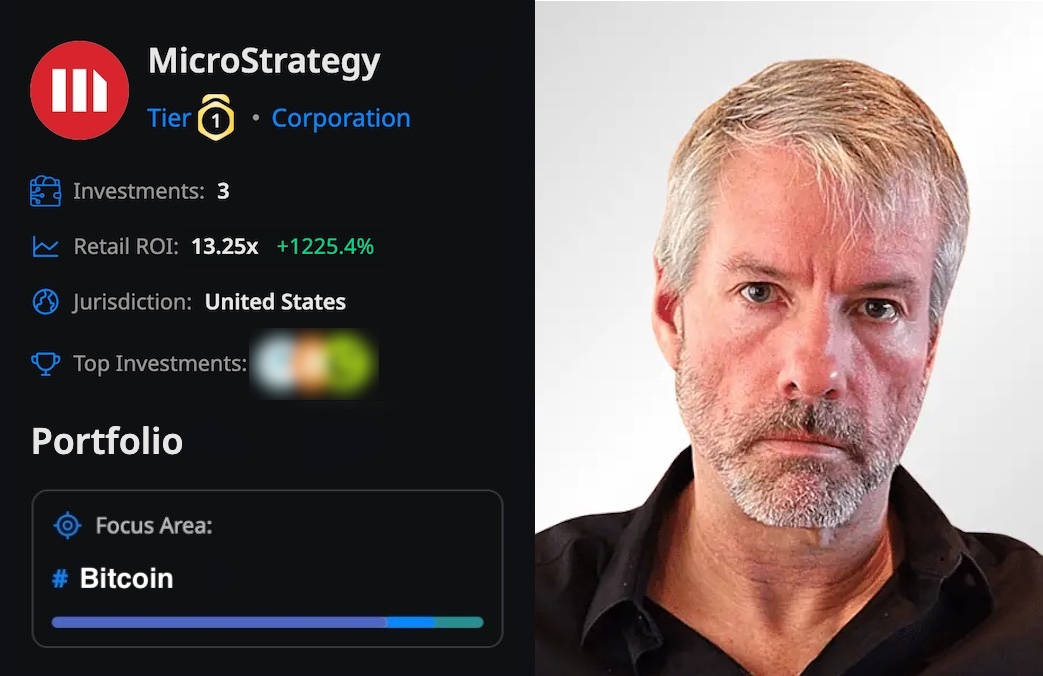
The world of financial markets is a fierce competition, and at the moment, Michael Saylor is leading the charge.
He is the executive chairman and co-founder of MicroStrategy, a company that raises equity and debt to acquire $BTC.

His journey started in 1983 when he enrolled at MIT with aspirations of becoming a pilot.
However, a medical condition prevented him from pursuing that dream, leading him to join The Federal Group in 1987, where he worked on computer simulation modeling for a software company.

In 1988, Saylor took on the role of internal consultant at DuPont, developing computer models to help the company anticipate shifts in its key markets.
These simulations forecasted a recession in many of DuPont's major markets by 1990.

In 1989, using funds from DuPont, Saylor founded MicroStrategy, initially developing software for data mining before shifting to business intelligence.
In 1992, the company secured a $10M contract with McDonald's to develop tools for analyzing promotional efficiency.
Saylor took MicroStrategy public in June 1998 with an initial offering of 4 million shares at $12 each.
The stock doubled on its first day, and by early 2000, Saylor’s net worth hit $7 billion, making him the wealthiest man in the D.C. area.

Saylor’s first major setback came in March 2000 when MicroStrategy announced it would restate its financial results.
The company’s shares dropped 62% after revealing its 1999 revenues were 25% lower than reported, and its profit was actually a loss.
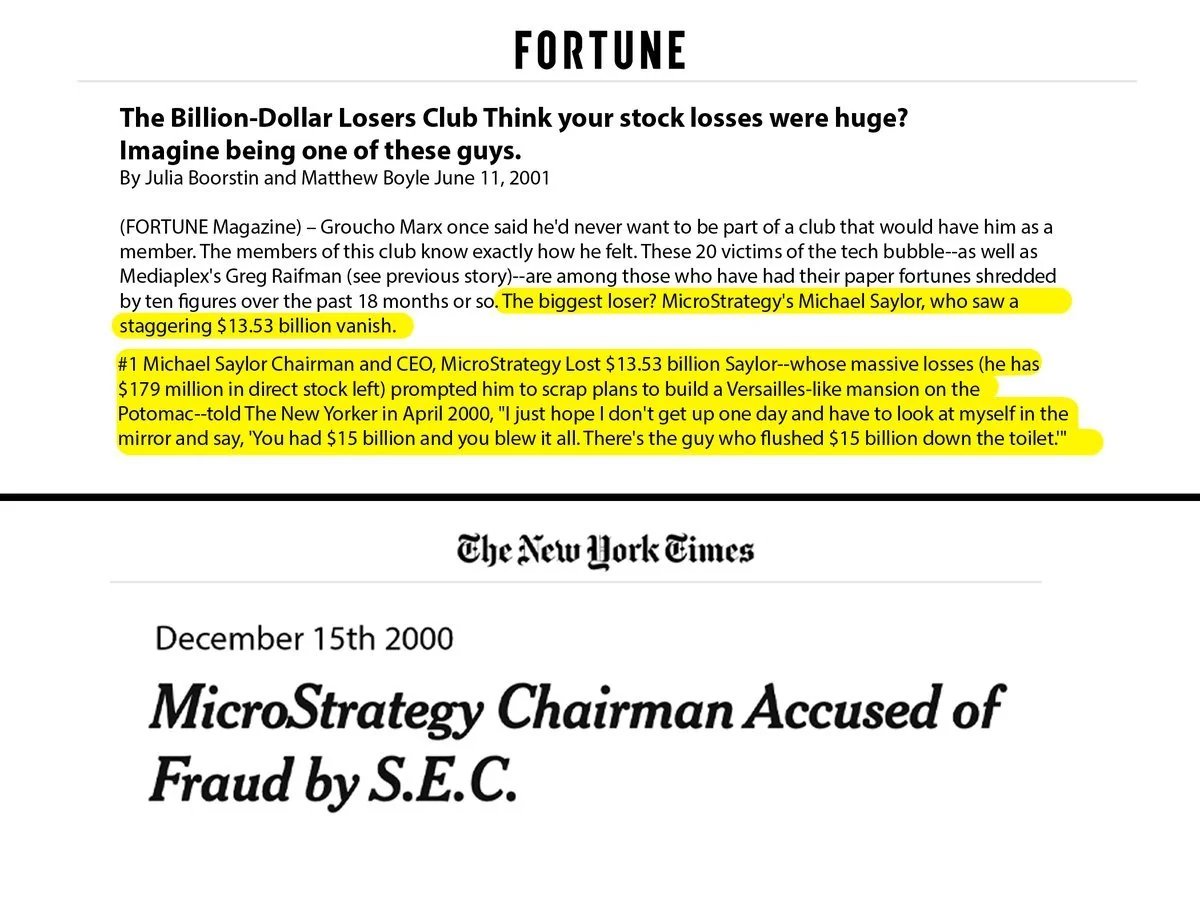
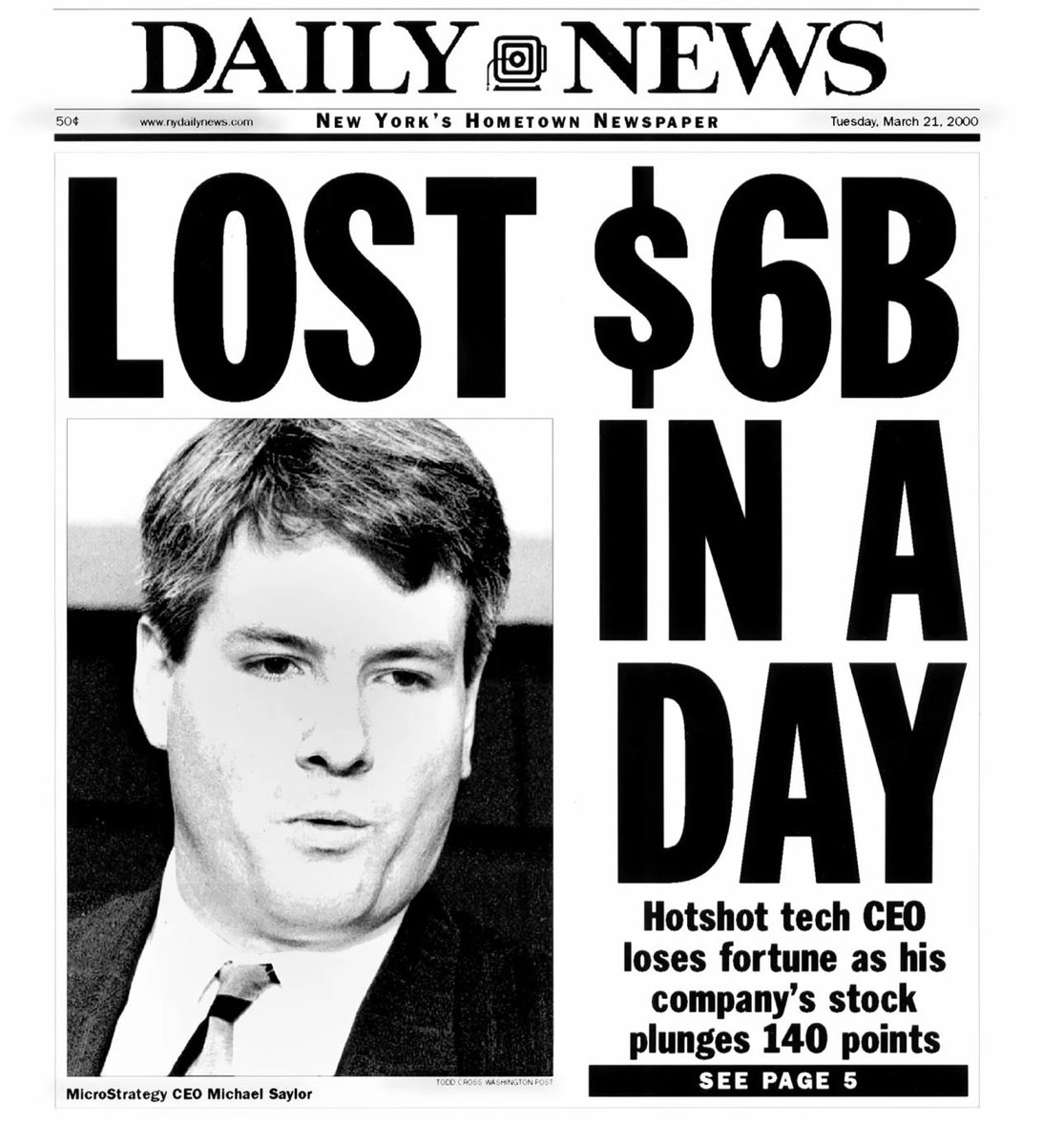
On March 20, 2000, Michael Saylor lost $6 billion, the largest single-day loss ever recorded by an individual.
In December 2000, the SEC filed fraud charges against MicroStrategy and its executives, which were eventually settled.
Saylor has always been tech-savvy and recognized digital scarcity long before Bitcoin’s first block was mined.
In the '90s, he had the foresight to start acquiring "premium" domain names: simple, one-word domains with broad potential appeal.
MicroStrategy spent $2M on premium domains like Angel[.]com, Alarm[.]com, and Wisdom[.]com, later making over $130M by selling them in the late '00s and early '10s.
Today, Saylor still owns his personal Michael[.]com and Mike[.]com domains.

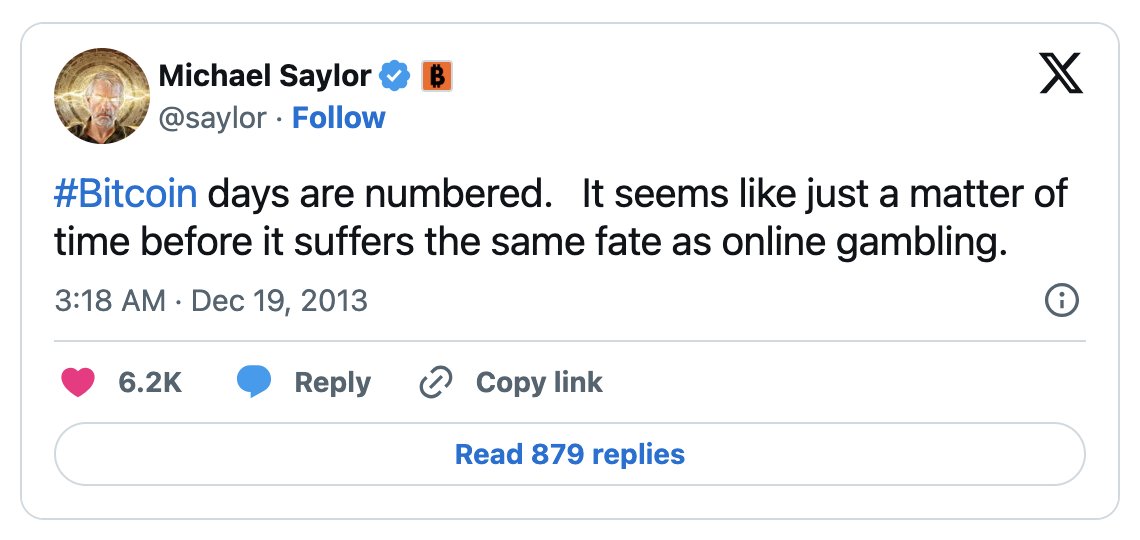
In December 2013, Saylor made his first public comment on Bitcoin, tweeting, “Without a credible sponsor, Bitcoin is at risk of being regulated out of existence”.
A week later, after Bitcoin had dropped by as much as two-thirds from its ATH of $1,242, he tweeted again.
Saylor returned to Bitcoin in mid-2020, announcing that MicroStrategy would start buying $BTC as part of a new capital strategy.
They allocated $250 million, completing the purchase of 21,454 $BTC at around $12,000 in just two weeks.
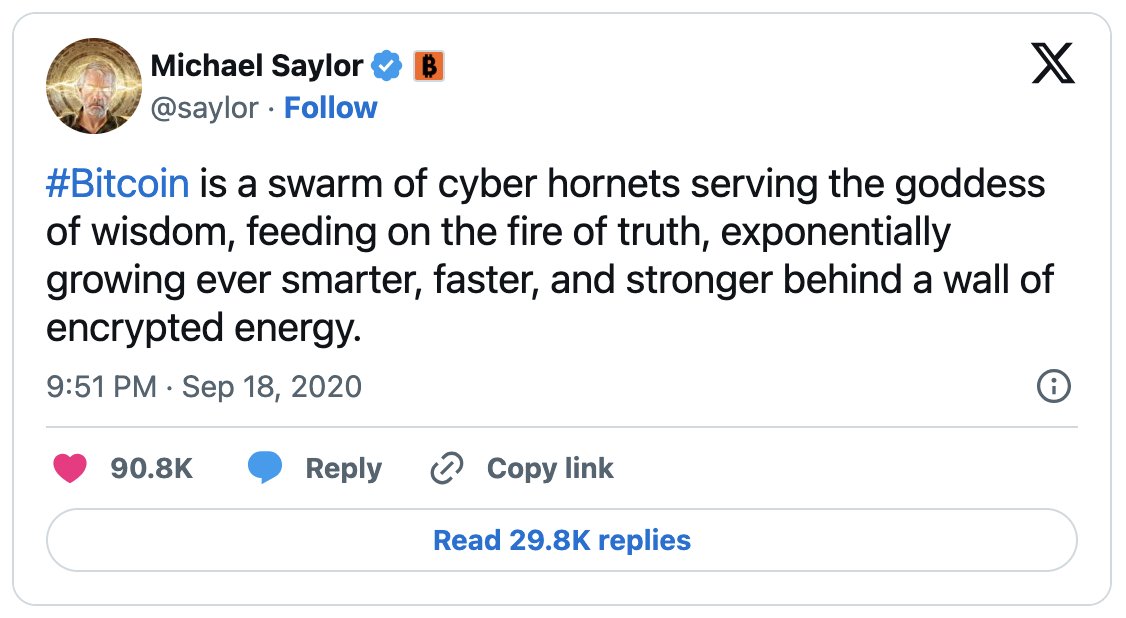
By December 2020, MicroStrategy launched its first debt sale since adopting Bitcoin - $400 million at 0.75% interest and committing the funds to purchase more Bitcoin.
This was followed by a second raise two months later and a third just four months after that.
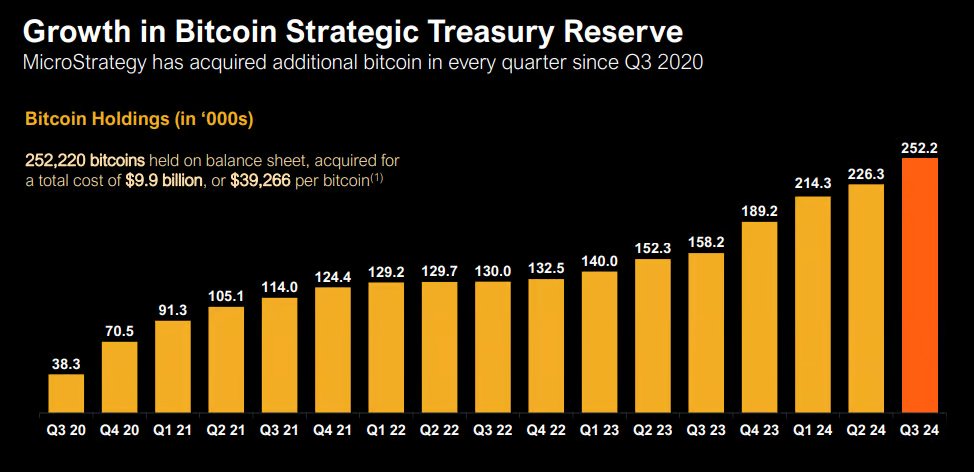
Since then, MicroStrategy has invested nearly $27.8 billion to acquire an additional 340,860 BTC, bringing the total to $28.7 billion.
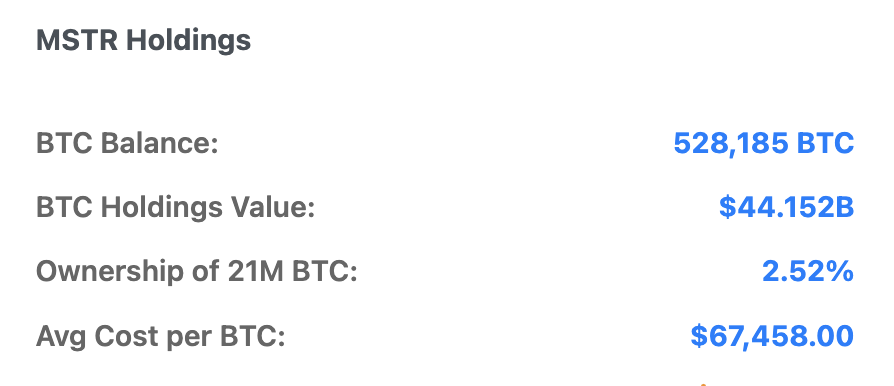
As of April 1, 2025, MicroStrategy holds 528,185 BTC which is 2.5% of the total circulating supply.
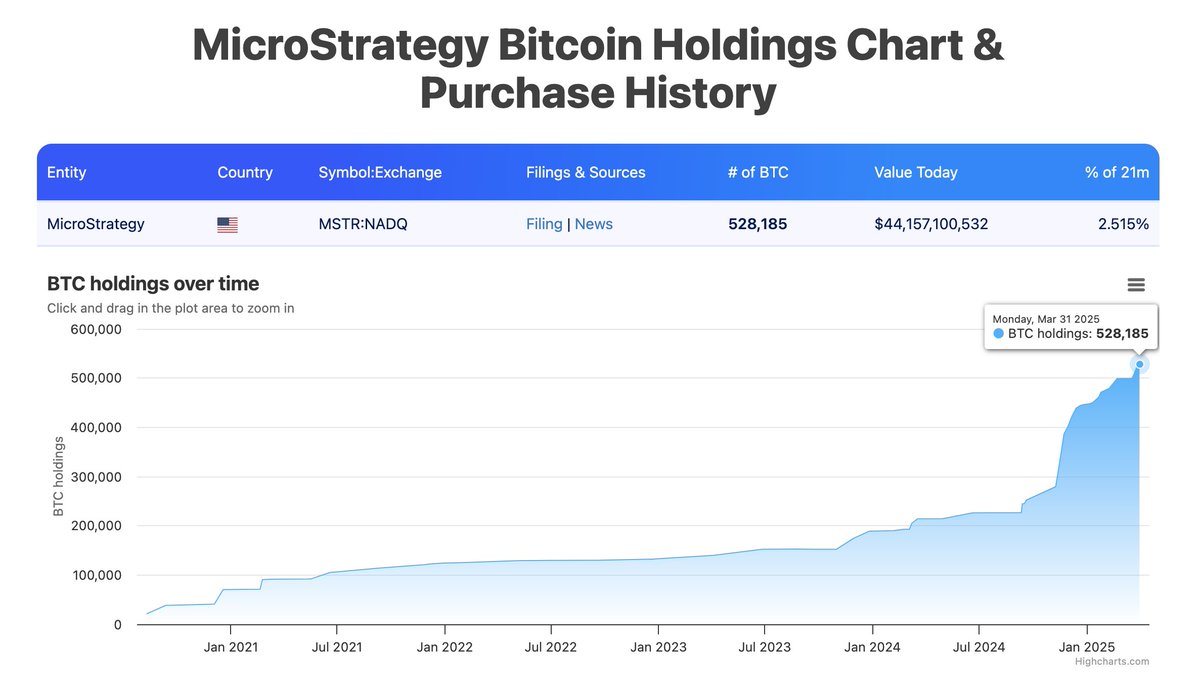
With an average purchase price of $67,458 per coin, the company's position is one of the largest and most influential in the crypto market.
While such a massive accumulation signals strong conviction in Bitcoin’s long-term potential, it also raises important concerns.
If the company were ever forced to liquidate a portion of its holdings, whether due to financial distress, margin calls, or broader economic pressures, it could trigger extreme volatility.
This could lead to rapid price declines and widespread panic across the crypto space.
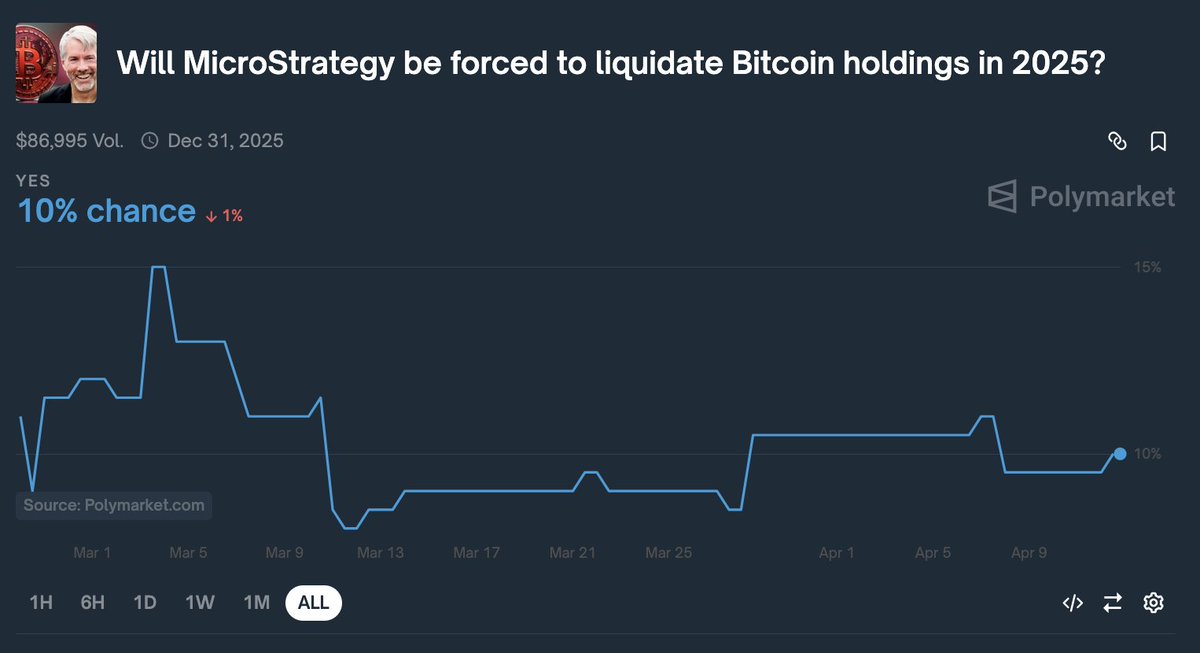
If Bitcoin falls well below MicroStrategy’s average buy-in, the company could struggle to meet its debt obligations and be forced to sell at depressed prices.
This selling could trigger a downward spiral, driving Bitcoin lower and pushing MicroStrategy closer to insolvency.
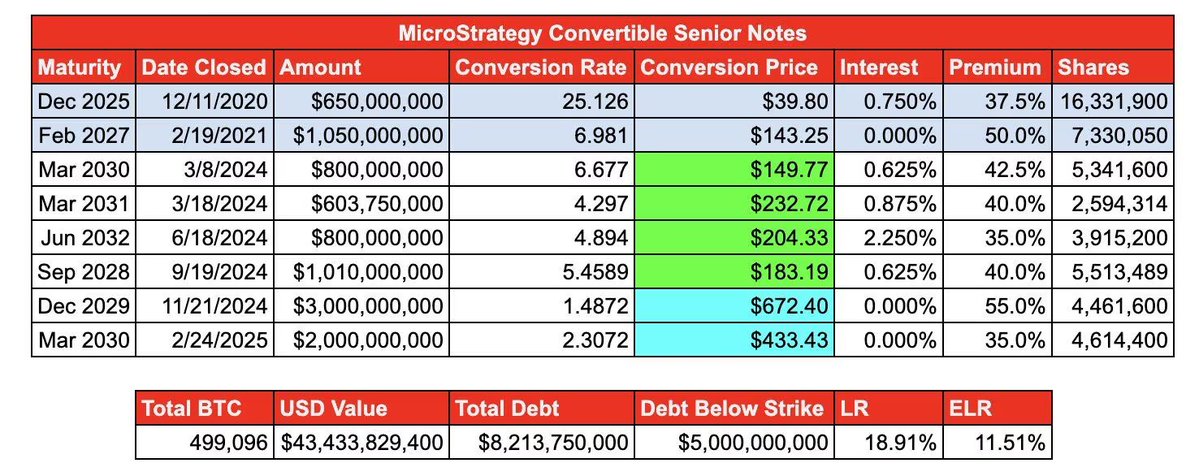
Given Michael Saylor’s commitment to $BTC, he’s unlikely to sell unless forced by extreme financial pressure.
However, if Bitcoin’s adoption continues to grow, MicroStrategy’s massive bet could prove to be one of the boldest and most successful moves in corporate history.
 Source
 Add to Favorites
 Download image
 Share x
 Copy link
Bitcoin may enter a prolonged sideways phase between $57K and $87K as markets enter a relief period following a 52% drop from ATH. This consolidation could mirror the 2022 fractal, creating liquidity before a potential breakdown toward the $44K–$50K range.
Doctor Profit/2026.03.09

Davinci Jeremie urged people to buy $1 of Bitcoin in 2013 and became a symbol of early conviction. Years later, fame, lifestyle flexing, and token promotions sparked criticism. His journey reflects both crypto foresight and influencer-era controversy.
StarPlatinum/2026.03.04
A sweeping narrative ties Jane Street to India’s expiry-day options case, alleged 10AM Bitcoin sell patterns, Terra’s collapse, and ETF plumbing. While none prove misconduct, critics argue a common structure: move spot, monetize derivatives, keep execution opaque.
Bull Theory/2026.02.27
A controversial narrative links Jane Street, ETF mechanics, and Bitcoin’s price behavior, pointing to lawsuit allegations, 10AM volatility patterns, and derivative hedging dynamics. The discussion raises broader questions about liquidity, structure, and price discovery.
Justin Bechler/2026.02.26
A new federal lawsuit alleges Jane Street exploited non-public information tied to Terraform’s liquidity defenses, accelerating UST’s depeg and the Terra collapse. The firm denies the claims. The case may reignite debates on structure, design, and regulation.
Diana/2026.02.25
Mean reversion and on-chain models sit at levels historically linked to bottom formation after capitulation. Realized losses reached record USD values, while deviations from anchor models remain extreme. Price pain may be fading; patience remains key.
Checkmate/2026.02.25
Hot feeds
A trader profits $448K by monitoring #Binance's new listings!
2024.12.13 17:37:29
Last week, funds have flowed into #Bitcoin, #Ethereum, and #Hyperliquid.
2024.12.16 14:48:36
A $PEPE whale that had been dormant for 600 days transferred all 2.1T $PEPE($52M) to a new address.
2024.12.14 10:35:27
When Elon Musk tweeted about Moltbook, the meme coin MOLT experienced a short-term 30% price surge, hitting a new all-time high of $114 million.
2026.01.31 18:37:29
A smart #AI coin trader made $17.6M on $GOAT, $ai16z, $Fartcoin,$arc.
2025.01.05 16:05:18
A sniper earned 2,277 $ETH ($8.3M) trading $SHIRO within 18 hours!
2024.12.03 23:09:08
MoreHot Articles
How did I turn $1,000 into $30,000 with smart money?
2024.12.09
10 promising AI Agent cryptos
2024.12.05
The 30-Year-Old Entrepreneur Behind Virtual, a Multi-Million Dollar AI Agent Society
2025.01.22
10 smart traders specializing in MEMEcoin trading on Solana
2024.12.09
A trader lost $73.9K trading memecoins in just 3 minutes — a lesson for us all!
2024.12.13
What is $SPORE? Let us take you through the on-chain records to show you how it works.
2024.12.25

