

 App Store
 Profile
 Security
 Sign Out
 Feeds
Feeds
 Articles
Tom Lees Ethereum Bet Falters as Corporate Crypto Dream Unwinds
 Bloomberg
Tom Lee’s Big Crypto Bet Buckles Under Mounting Market Strain
Ethereum’s corporate-buying experiment is unraveling in real time.
The world’s second-largest cryptocurrency dropped below $3,400 on Tuesday, sliding in tandem with market bellwether Bitcoin and tech stocks as Wall Street’s AI-fueled exuberance fades. The move has pushed Ether 30% below its August peak, returning prices to levels last seen before a wave of corporate buying and holding, further cementing the token’s entry into a bear market.

That reversal has left Bitmine Immersion Technologies Inc., Ethereum’s most aggressive corporate backer, facing more than $1.3 billion in paper losses, according to research firm 10x Research. The publicly traded company, backed by billionaire Peter Thiel and headed by Wall Street forecaster Tom Lee, modeled its strategy on Michael Saylor’s Bitcoin-treasury playbook, acquiring 3.4 million Ether at an average of $3,909. With its war chest fully deployed, Bitmine is now under mounting pressure.
“For months, Bitmine drove the narrative and the flow,” 10x wrote in a report. “Now it’s fully deployed, sitting on over $1.3 billion in unrealized losses with no dry powder left.”
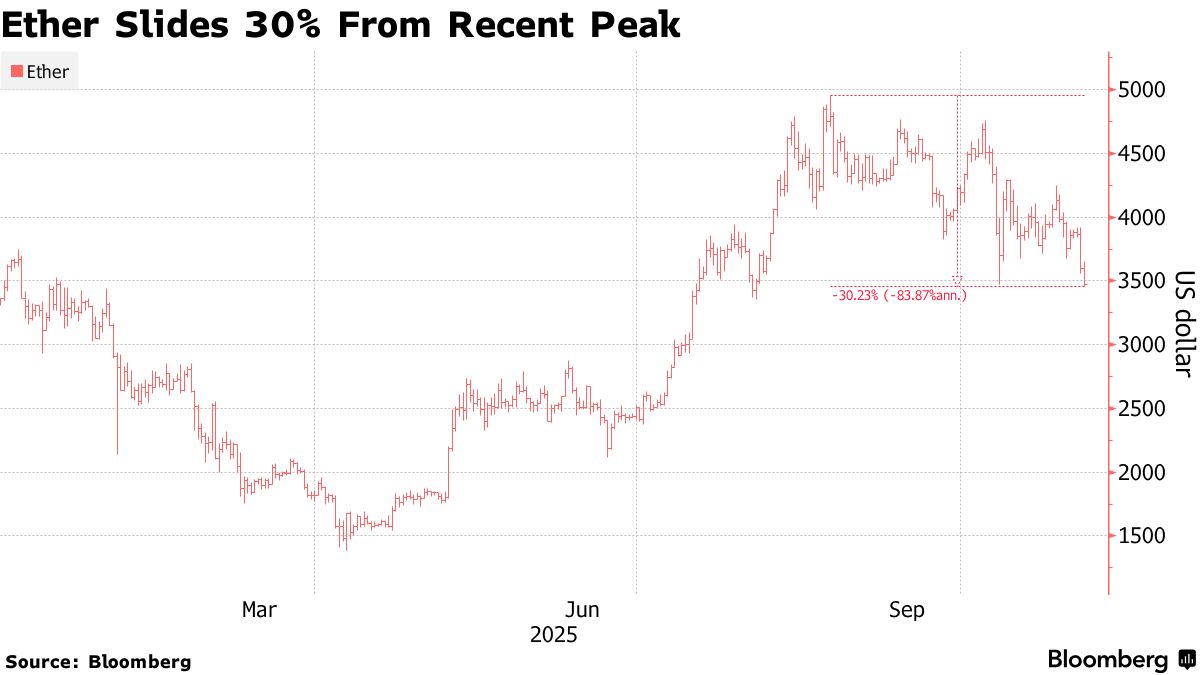
Retail investors who bought Bitmine shares at a premium to its net asset value (NAV) have been hit even harder, the report noted, with limited appetite to “catch a falling knife.”
Lee, the co-founder and managing partner of Fundstrat Global Advisors who also serves as chairman of Bitmine, didn’t immediately respond to a request for comment. Representatives of Bitmine also didn’t immediately respond.
Bitmine’s wager was never just a balance-sheet trade. The company’s accumulation embodied a bigger idea that digital assets could move from speculation to corporate finance infrastructure, cementing Ethereum’s place in the financial mainstream. By locking Ether into public-company treasuries, believers argued, firms would help bootstrap a new decentralized economy where code replaces contracts and tokens function as assets.
That thesis helped power a summer rally, lifting Ether to nearly $5,000 while Ethereum ETFs drew more than $9 billion in inflows in July and August alone. But since an Oct. 10 crypto market wipeout, the tide has turned: $850 million has exited Ethereum ETFs since, and open interest in Ether futures has fallen by $16 billion, according to Coinglass and data compiled by Bloomberg.
Lee has predicted Ether would reach $16,000 by the end of this year.
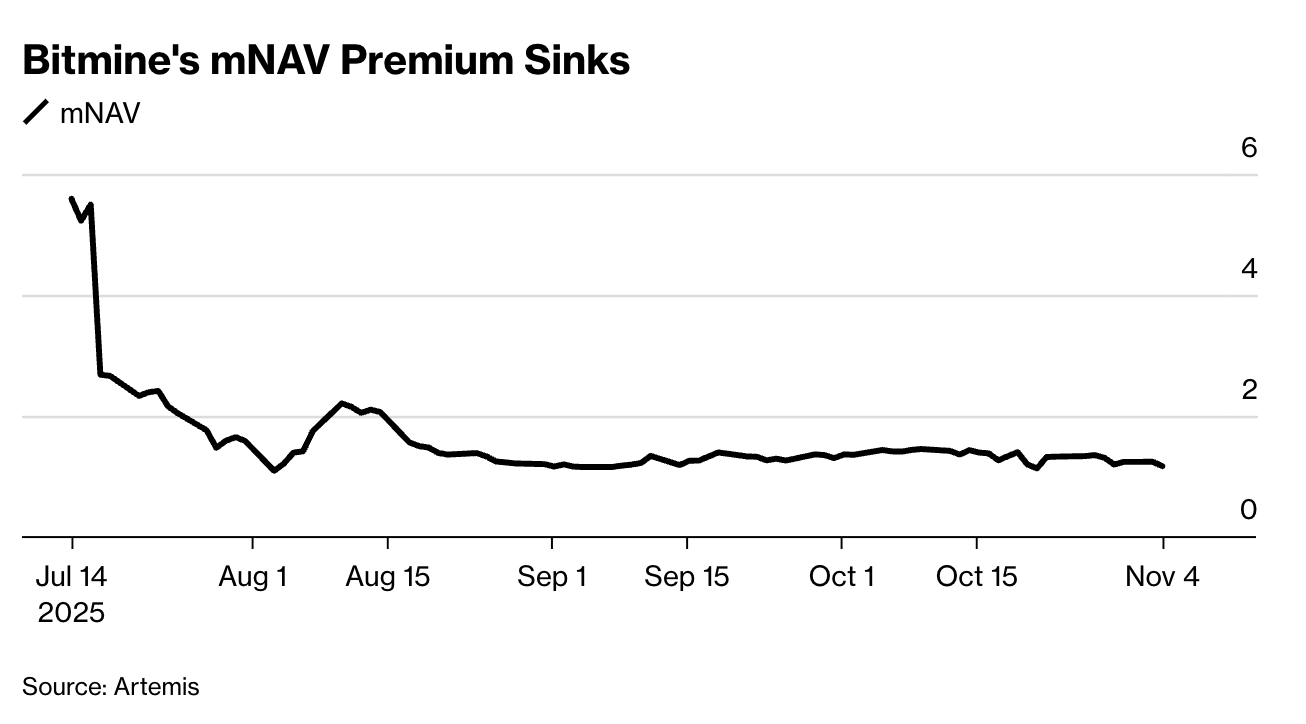
Bitmine’s market-cap-to-net-asset-value multiple has plunged from 5.6 in July to 1.2, according to data from Artemis, while its stock has dropped 70% from its peak. Like Bitcoin-linked companies before it, Bitmine’s equity now trades closer to its underlying holdings, as the market re-rates the once-lofty multiples attached to balance-sheet crypto.
Last week ETHZilla, another publicly-listed Ether treasury firm, sold $40 million of its holdings to buy back its shares in order to normalize its mNAV ratio. “ETHZilla plans to use the remaining proceeds of its ETH sale for additional share repurchases and intends to continue to sell ETH to repurchase its shares until the discount to NAV is normalized,” the company said in a press release at the time.
Even with the price decline, Ethereum’s long-term fundamentals still appear robust: it continues to process more on-chain value than any rival smart-contract network, and its staking mechanism has made the token both yield-bearing and deflationary. Yet with competitors like Solana gaining traction, ETF flows reversing, and retail interest fading, the narrative that corporations could stabilize crypto prices is faltering.
 Source
 Add to Favorites
 Download image
 Share x
 Copy link
Bitcoin may enter a prolonged sideways phase between $57K and $87K as markets enter a relief period following a 52% drop from ATH. This consolidation could mirror the 2022 fractal, creating liquidity before a potential breakdown toward the $44K–$50K range.
Doctor Profit/2026.03.09

Davinci Jeremie urged people to buy $1 of Bitcoin in 2013 and became a symbol of early conviction. Years later, fame, lifestyle flexing, and token promotions sparked criticism. His journey reflects both crypto foresight and influencer-era controversy.
StarPlatinum/2026.03.04
A sweeping narrative ties Jane Street to India’s expiry-day options case, alleged 10AM Bitcoin sell patterns, Terra’s collapse, and ETF plumbing. While none prove misconduct, critics argue a common structure: move spot, monetize derivatives, keep execution opaque.
Bull Theory/2026.02.27
A controversial narrative links Jane Street, ETF mechanics, and Bitcoin’s price behavior, pointing to lawsuit allegations, 10AM volatility patterns, and derivative hedging dynamics. The discussion raises broader questions about liquidity, structure, and price discovery.
Justin Bechler/2026.02.26
A new federal lawsuit alleges Jane Street exploited non-public information tied to Terraform’s liquidity defenses, accelerating UST’s depeg and the Terra collapse. The firm denies the claims. The case may reignite debates on structure, design, and regulation.
Diana/2026.02.25
Mean reversion and on-chain models sit at levels historically linked to bottom formation after capitulation. Realized losses reached record USD values, while deviations from anchor models remain extreme. Price pain may be fading; patience remains key.
Checkmate/2026.02.25
Hot feeds
A trader profits $448K by monitoring #Binance's new listings!
2024.12.13 17:37:29
Last week, funds have flowed into #Bitcoin, #Ethereum, and #Hyperliquid.
2024.12.16 14:48:36
A $PEPE whale that had been dormant for 600 days transferred all 2.1T $PEPE($52M) to a new address.
2024.12.14 10:35:27
When Elon Musk tweeted about Moltbook, the meme coin MOLT experienced a short-term 30% price surge, hitting a new all-time high of $114 million.
2026.01.31 18:37:29
A smart #AI coin trader made $17.6M on $GOAT, $ai16z, $Fartcoin,$arc.
2025.01.05 16:05:18
A sniper earned 2,277 $ETH ($8.3M) trading $SHIRO within 18 hours!
2024.12.03 23:09:08
MoreHot Articles
How did I turn $1,000 into $30,000 with smart money?
2024.12.09
10 promising AI Agent cryptos
2024.12.05
The 30-Year-Old Entrepreneur Behind Virtual, a Multi-Million Dollar AI Agent Society
2025.01.22
10 smart traders specializing in MEMEcoin trading on Solana
2024.12.09
A trader lost $73.9K trading memecoins in just 3 minutes — a lesson for us all!
2024.12.13
What is $SPORE? Let us take you through the on-chain records to show you how it works.
2024.12.25

