
Lookonchain APP

App Store

Fusionist hacked for $2M: attacker mints $ACE, dumps on exchanges, converts to ETH and deposits into TornadoCash

39 minutes ago

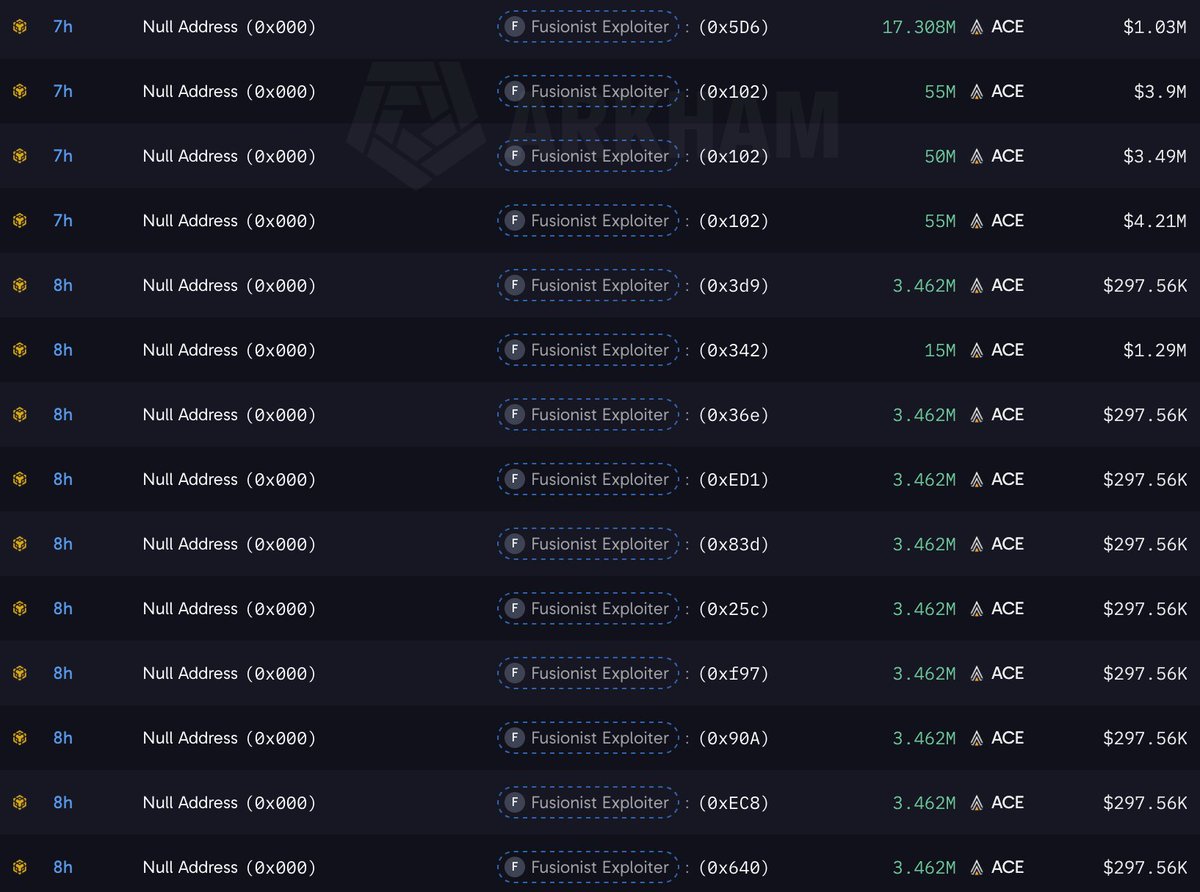
Fusionist (@fusionistio) was hacked for over $2M!

The attacker minted and dumped a large amount of $ACE, sending some to Gate, MEXC, and Baltex to sell.

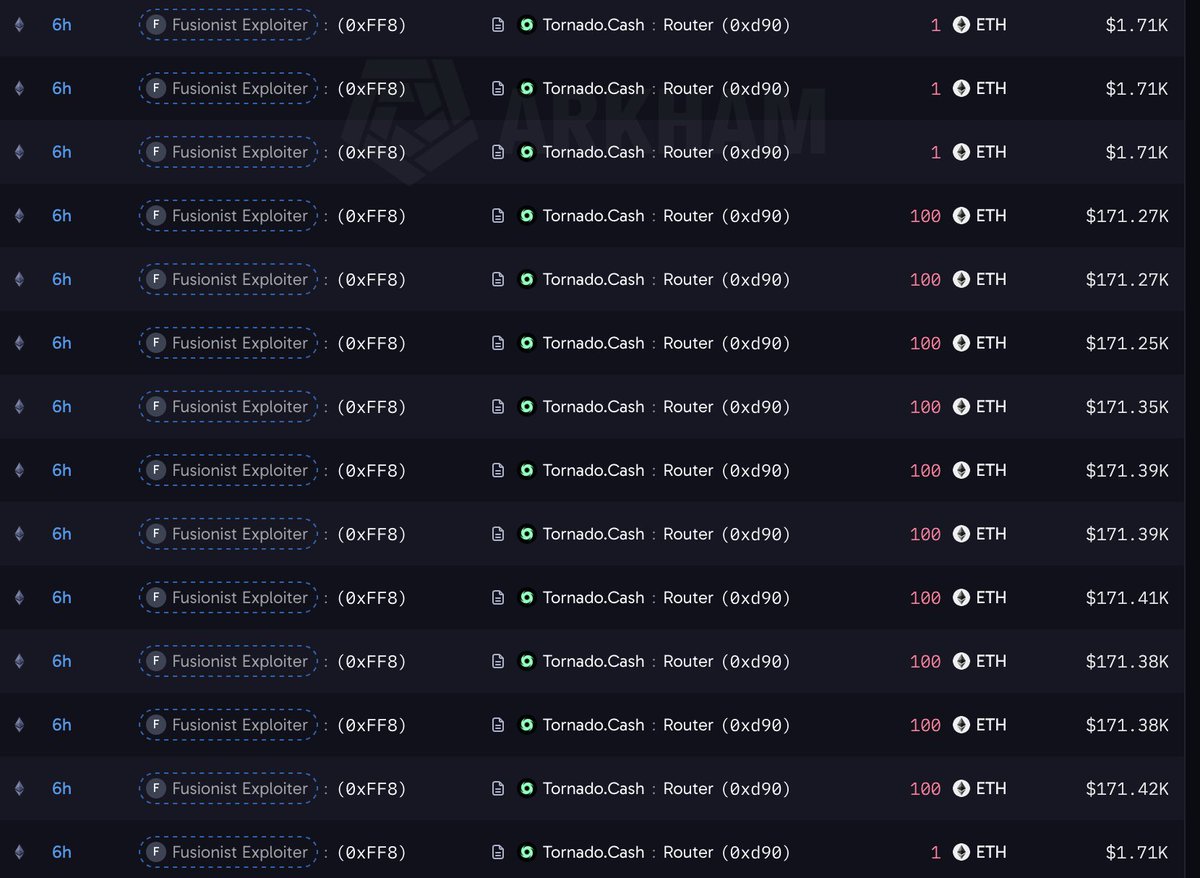
The attacker then swapped the funds for $ETH and has already deposited 1,150 $ETH ($1.97M) into #TornadoCash.
Relevant content

Arthur Hayes: Flop Labs’ Devnet activity is on the rise, testnet is approaching.

BitMEX co-founder Arthur Hayes noted in a post that Flop Labs’ Devnet is experiencing increased activity ahead of its testnet launch, with some participants already beginning preparations. The current FLOP Devnet has a block height of 4,404,681, a TPS of 47, an average block time of 1 second, cumulative transactions exceeding 11.59 million, and a gradually rising network activity chart.

1 seconds ago

South Korea's KOSPI index triggers sidecar mechanism, suspending program selling for 5 minutes.

Korea Exchange (KRX) has activated the sell-side sidecar mechanism for KOSPI, suspending programmatic sell trading of KOSPI constituent stocks. Under the mechanism, a five-minute pause on programmatic sell trading will be triggered if the KOSPI 200 futures index falls by 5% or more and remains at that decline for at least one minute.

1 seconds ago

Databricks, with annualized revenue exceeding $7 billion, plans to raise additional funding at a $225 billion valuation.

Beating AI News reports that enterprise data and AI software giant Databricks is in early-stage talks for a new multibillion-dollar funding round, targeting a valuation of up to $225 billion. In August this year, Databricks raised $5 billion at a $190 billion valuation. In just the past three months, the new round’s target valuation has risen by $35 billion, an increase of roughly 18.4%. Compared to its $62 billion valuation at the end of 2024, the company’s value has grown approximately 2.6 times. Databricks primarily helps enterprises store, manage, and analyze massive datasets, and build AI applications on top of this infrastructure. This year, the company doubled down on AI agents, launching Genie (which allows employees to directly query enterprise data), Lakebase (an agent-oriented database), and Unity AI Gateway (which centrally manages different AI models and their inference costs). The company has delivered strong growth: its annualized revenue run rate, disclosed in August, exceeded $70 billion, growing over 80% year-over-year, and it posted positive adjusted free cash flow over the past 12 months. The $225 billion valuation equals roughly 32 times its annualized revenue. Databricks remains private to date. Ghodsi said on the November 17 episode of the All-In Podcast that the company will eventually go public, but the current AI industry is too volatile, and stock price fluctuations could easily impact employees, so it prefers to stay private for now. The company allows employees to sell a portion of their shares annually, so they do not have to wait for an IPO to monetize their holdings.

1 seconds ago

Bank of America: Semiconductor stocks need interest rates to peak to sustain their bottoming process, advises waiting until share prices are no longer impacted by negative news before bottom-fishing.

BofA Securities analyst Vivek Arya and colleagues noted in a recent report that peaking interest rates are a necessary condition for the Philadelphia Semiconductor Index (SOX) to form a sustainable bottom. Rising financing costs are testing the sustainability of AI capital expenditures (capex). If cloud providers fail to maintain their current spending pace, capex could be cut by around 20% in 2027, and AI chipmakers’ earnings per share (EPS) could face a 35% to 40% downside. BofA estimates that the combined free cash flow of cloud providers will drop from $226 billion in 2024 to negative $140 billion in 2026, and worsen further to negative $361 billion in 2027. Analysts argue that rising interest rates will increase financing costs, reduce returns on AI projects, and force some low-return projects to be scrapped. However, BofA notes that chip stocks typically bottom out ahead of their fundamentals. Historical data shows the SOX usually hits a bottom 2 to 6 months before earnings bottom, and posts an average rebound of around 42% in the year after earnings cuts are priced in by the market. Therefore, investors should not wait for chip firms like NVIDIA and Broadcom to cut their earnings guidance before taking action. BofA advises focusing on four key signals: peaking interest rates, cloud providers starting to reset capex, quantifiable EPS cuts for chipmakers, and chip stocks no longer declining amid sustained negative news. Before these signals emerge, reduce direct exposure to the AI capex chain; once the signals converge, prioritize leading players like NVIDIA and Broadcom, then gradually shift to high-elasticity sectors such as optical modules, connectors, and semiconductor equipment. The report concludes that investors do not need to wait for positive news, but rather for interest rates to peak and for "bad news to no longer push chip stocks lower."

1 seconds ago

Whale 0x5011 buys 667.34B $PEPE ($2.27M), totaling 2.565T in 5 days

Whale 0x5011 bought another 667.34B $PEPE ($2.27M)! Over the past 5 days, the whale has bought a total of 2.565T $PEPE ($9.42M).

1 seconds ago

Taiwan Weighted Index reverses its decline, latest up 1.6%

According to Bitget market data, the Taiwan Weighted Index reversed its earlier decline, rising 1.6% to a latest level of 36594.73 points.

1 seconds ago

Popular tokens

BitcoinEthereumHyperliquidSolanaTRONBNBTetherAaveXRPPepeFartcoinOndoJupiterUniswapBonkPendleEthenaArbitrumAvalancheLidoChainlinkPolygonDogecoinCardano