

 App Store
 Profile
 Security
 Sign Out
 Feeds
Feeds
 Articles
The $OM Crash: A Lesson in Token Transparency and Market Risks
 Sjuul | AltCryptoGems
$OM is the $LUNA of this cycle.
$6B+ wiped out within 30 minutes.
But why did it happen?
🧵: THE $OM CRASH DECODED👇
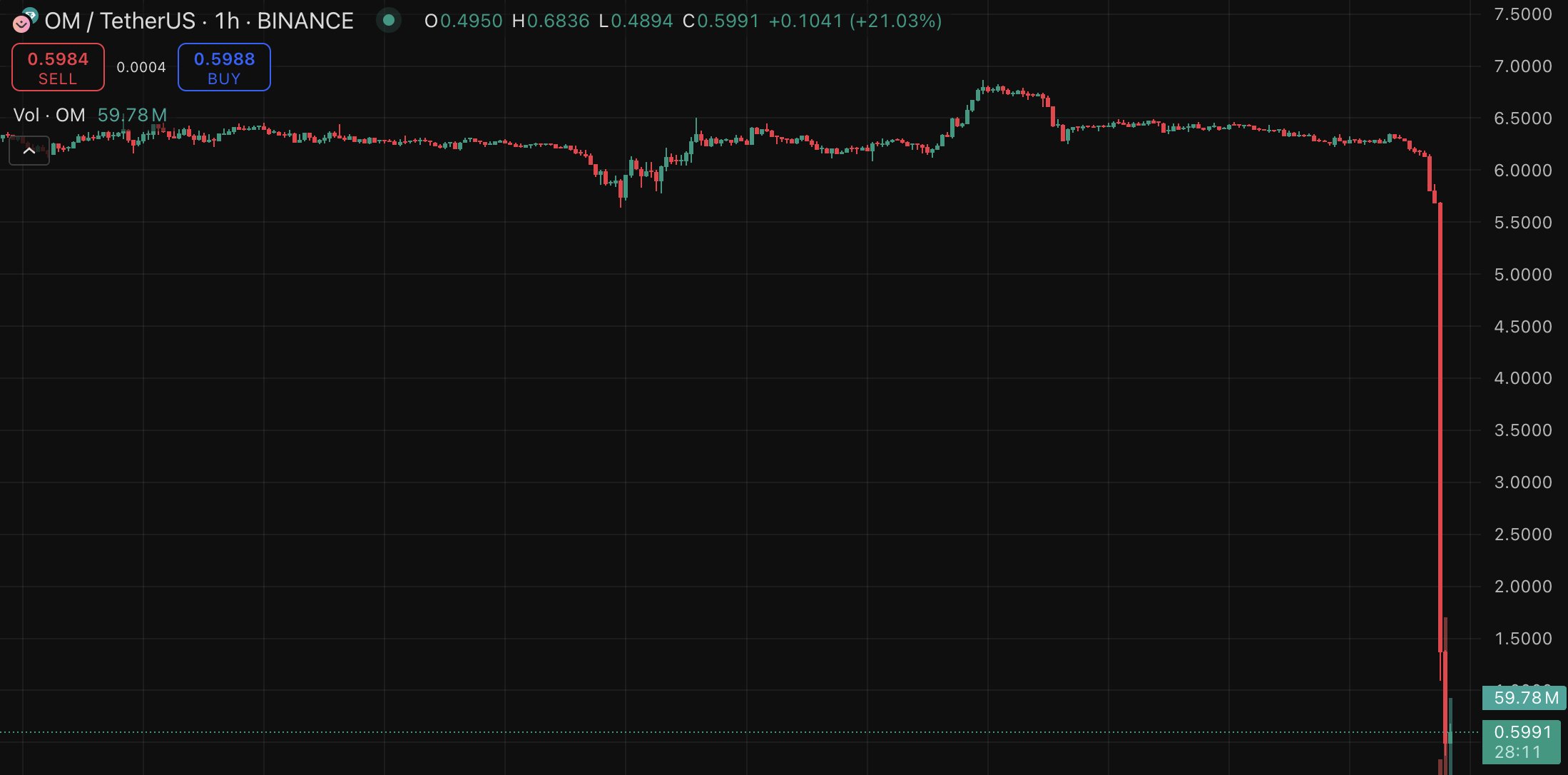
It all started when a wallet believed to be connected to the @MANTRA_Chain team, suddenly deposited 3.9 million $OM tokens on the exchange OKX.
This got a lot of attention. And here’s why...
The OM team reportedly controls about 90% of the token's total supply.
That means just a few people have most of the power over the token’s price. That’s already a big red flag.
Over the past year, there were already trust issues in the community.
Some of the concerns included:
The team was allegedly using market makers to keep the price up artificially
They quietly changed the token’s economics
And they kept delaying a promised community airdrop
People were already on edge.
So when that large token deposit hit OKX, people started to worry that a big sell-off was coming.
And they were right.
Selling pressure began shortly after.
But the situation got a lot worse because of something else: OTC (over-the-counter) deals.
There were rumors that OM had made private deals with investors, offering tokens at huge discounts — some at 50% off or even more.
So when the price dropped by 50%, all those OTC buyers were suddenly at a loss.
And panic kicked in.
Everyone wanted to exit before the price fell further.
This led to a chain reaction:
More people sold
Stop-losses were triggered
Leverage positions started getting liquidated
The market basically collapsed
All of this happened within one hour. And the price dropped 90%.
This wasn’t just a price dip.
It was a full-on meltdown.
Over $5.5 billion in value vanished in no time.
A lot of people got burned — including those who had no idea what was going on behind the scenes.
So what’s the takeaway?
Be careful with tokens where:
A small group holds most of the supply
The team isn't transparent
Promises keep getting delayed
The price seems too stable or too good to be true
Always take the time to do your research before putting your money into anything.
It might save you from situations like this.
 Source
 Add to Favorites
 Download image
 Share x
 Copy link
Bitcoin may enter a prolonged sideways phase between $57K and $87K as markets enter a relief period following a 52% drop from ATH. This consolidation could mirror the 2022 fractal, creating liquidity before a potential breakdown toward the $44K–$50K range.
Doctor Profit/2026.03.09

Davinci Jeremie urged people to buy $1 of Bitcoin in 2013 and became a symbol of early conviction. Years later, fame, lifestyle flexing, and token promotions sparked criticism. His journey reflects both crypto foresight and influencer-era controversy.
StarPlatinum/2026.03.04
A sweeping narrative ties Jane Street to India’s expiry-day options case, alleged 10AM Bitcoin sell patterns, Terra’s collapse, and ETF plumbing. While none prove misconduct, critics argue a common structure: move spot, monetize derivatives, keep execution opaque.
Bull Theory/2026.02.27
A controversial narrative links Jane Street, ETF mechanics, and Bitcoin’s price behavior, pointing to lawsuit allegations, 10AM volatility patterns, and derivative hedging dynamics. The discussion raises broader questions about liquidity, structure, and price discovery.
Justin Bechler/2026.02.26
A new federal lawsuit alleges Jane Street exploited non-public information tied to Terraform’s liquidity defenses, accelerating UST’s depeg and the Terra collapse. The firm denies the claims. The case may reignite debates on structure, design, and regulation.
Diana/2026.02.25
Mean reversion and on-chain models sit at levels historically linked to bottom formation after capitulation. Realized losses reached record USD values, while deviations from anchor models remain extreme. Price pain may be fading; patience remains key.
Checkmate/2026.02.25
Hot feeds
A trader profits $448K by monitoring #Binance's new listings!
2024.12.13 17:37:29
Last week, funds have flowed into #Bitcoin, #Ethereum, and #Hyperliquid.
2024.12.16 14:48:36
A $PEPE whale that had been dormant for 600 days transferred all 2.1T $PEPE($52M) to a new address.
2024.12.14 10:35:27
When Elon Musk tweeted about Moltbook, the meme coin MOLT experienced a short-term 30% price surge, hitting a new all-time high of $114 million.
2026.01.31 18:37:29
A smart #AI coin trader made $17.6M on $GOAT, $ai16z, $Fartcoin,$arc.
2025.01.05 16:05:18
A sniper earned 2,277 $ETH ($8.3M) trading $SHIRO within 18 hours!
2024.12.03 23:09:08
MoreHot Articles
How did I turn $1,000 into $30,000 with smart money?
2024.12.09
10 promising AI Agent cryptos
2024.12.05
The 30-Year-Old Entrepreneur Behind Virtual, a Multi-Million Dollar AI Agent Society
2025.01.22
10 smart traders specializing in MEMEcoin trading on Solana
2024.12.09
A trader lost $73.9K trading memecoins in just 3 minutes — a lesson for us all!
2024.12.13
What is $SPORE? Let us take you through the on-chain records to show you how it works.
2024.12.25

